
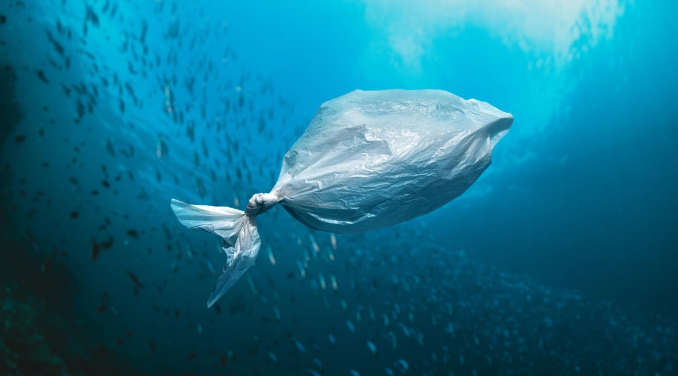
In Southeast Asia, plastic bottles occasionally float into the roots of mangrove swamps like trapped jellyfish along their coastline. The water flashes in the sunlight. Mud is traversed by crabs. Bright blue detergent caps and faded soda bottles slowly gather among the leaves, creating a silent archive of contemporary consumption. Scientists believed for years that those plastics would remain in place for centuries. The assumption was that. As it happens, nature might have been trying out a different strategy.
Researchers have discovered microorganisms beneath the ocean’s surface that carry an unusual molecular tool: an enzyme that can degrade PET plastic, the same substance found in synthetic clothing and water bottles. The enzyme, called PETase, accomplishes an almost impossible task. In essence, it transforms solid waste into usable building blocks by cutting long plastic molecules into smaller chemical pieces.
| Category | Information |
|---|---|
| Discovery Focus | Plastic-digesting ocean microbes |
| Key Enzyme | PETase (plastic-degrading enzyme) |
| Plastic Target | PET (Polyethylene terephthalate) used in bottles and fabrics |
| Discovery Context | Marine bacteria evolving to consume plastic waste |
| First Major Breakthrough | Identification of plastic-eating bacterium Ideonella sakaiensis |
| Ocean Research Institution | King Abdullah University of Science & Technology (KAUST) |
| Key Enzyme Feature | M5 motif enabling effective PET breakdown |
| Ocean Presence | PETase variants found in nearly 80% of ocean samples |
| Potential Application | Industrial recycling and plastic waste treatment |
| Reference Source | The Guardian |
Scientists have been discussing the discovery with a mix of caution and excitement. For a long time, PET plastic was thought to be practically eternal. It could take hundreds of years for a normal bottle to break down. However, these microorganisms seem to be developing new ways to break it down. Given the unexpected influx of man-made polymers, nature might be subtly changing in real time.
Recently, scientists at King Abdullah University of Science and Technology examined hundreds of ocean samples to look for signs of genes that break down plastic. Even seasoned microbiologists were shocked by what they discovered.
Nearly 80 percent of the ocean environments they examined had variations of the enzyme, ranging from dark waters almost two kilometers below the surface to floating garbage patches close to the surface. There is a feeling that something subtle but global is occurring beneath the waves as you watch the data pile up.
The “M5 motif,” a structural element, seems to be the key. Researchers refer to it as a molecular fingerprint that indicates when an enzyme is actually able to degrade plastic. Microbes with this trait were able to break down PET materials much more efficiently in lab tests than previous strains that only scratched the surface.
It is difficult to avoid visualizing the microscopic scene. Like diners around a buffet table, bacteria congregate around pieces of plastic in a droplet of seawater. The polymer chains are bent, twisted, and snapped apart by enzymes that bind to them. Yes, slow chemistry, but chemistry that wasn’t meant to occur in the natural world.
The notion that plastic waste may eventually be broken down by microbes is not a novel one. Ideonella sakaiensis is a bacterium that was found in 2016 by researchers looking into a recycling facility in Japan. It used PETase to break down plastic bottles into simpler molecules so it could survive. The discovery seemed like a curiosity at the time. Perhaps fascinating biology, but not necessarily a fix for the world’s waste issue.
The narrative feels different now. The process may be spreading through evolution itself, as marine microbes seem to be independently creating similar tools. Plastic waste might just appear to be another possible food source in oceans with low carbon levels. It has an odd logic to it.
However, enthusiasm is accompanied by caution. When compared to the extent of plastic pollution worldwide, even the fastest natural enzymes function slowly. Approximately 380 million tons of plastic are produced annually by humanity. For now, the microbes nibble instead of consuming. The mess that humans have made cannot be cleaned up by nature alone, according to scientists who are researching the phenomenon.
Engineers are still working to speed up the process in spite of this. To make the PETase enzyme faster and more stable, scientists are adjusting its genetic code in labs ranging from Texas to France. Compared to the natural enzyme, some engineered versions of the enzyme already break down plastic much more quickly, sometimes turning materials into reusable chemicals in a matter of days as opposed to decades.
One such experiment has quietly transcended theory inside an industrial facility in Clermont-Ferrand, France. Inside tall steel tanks that resemble brewery fermentation vessels, concentrated enzymes are combined with shredded plastic waste. The plastic gradually dissolves into liquid chemical components as the reaction goes on, allowing for the creation of new plastic. The plastic flakes gradually fade, swirling like snow before completely vanishing as the process is observed through glass reactors.
Investors appear interested but cautious. In the past, recycling technologies have promised breakthroughs, but many of them have quietly failed. However, this method—using natural tools and accelerating them in the lab—feels unique. Rather than creating everything from the ground up, it takes inspiration from evolution.
Additionally, the solution’s origin has an oddly poetic quality. It’s possible that the microbes that are learning to break down floating debris are present in the same oceans. It’s difficult not to feel both hopeful and humbled as you watch this play out.
The microbes were not asked to solve the plastic problem for humanity, after all. They just adjusted. It’s unclear if their microscopic enzymes will grow into a global cleanup system. However, evolution is already experimenting with the concept somewhere in the murky waters beneath floating bottles and plastic bags.