
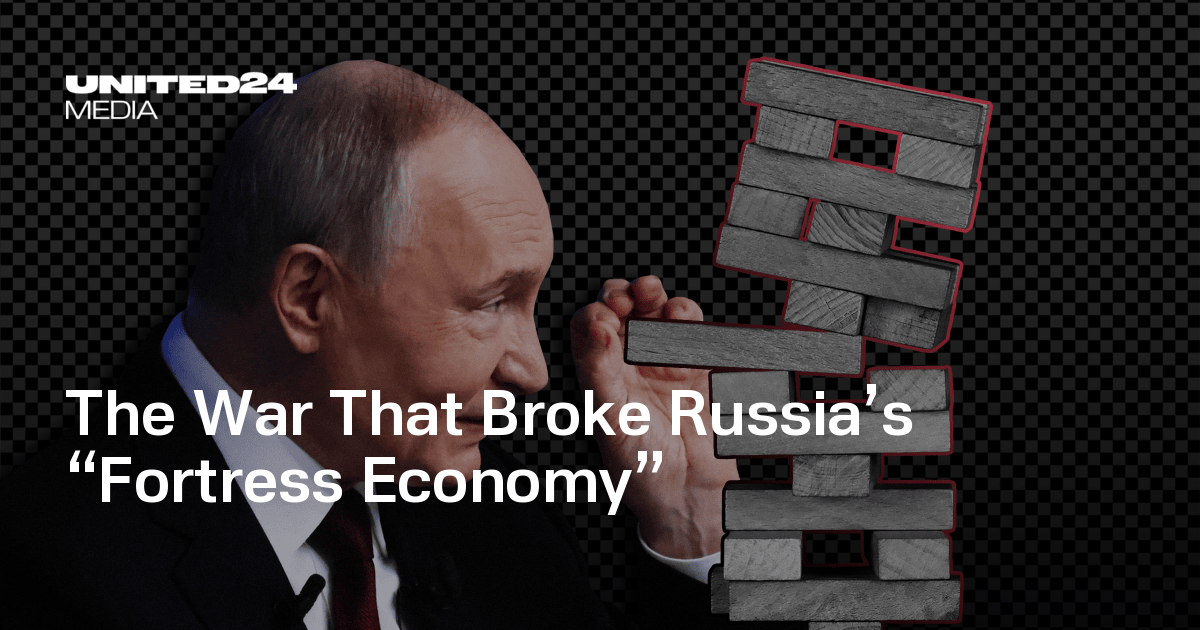
Russia’s economy is experiencing a full-scale degradation as the war in Ukraine enters its fourth year, according to a recent analysis. What was once described as “Fortress Russia”—an economy insulated by vast reserves and conservative fiscal policy—has now been fundamentally reshaped by the ongoing military conflict. The Russian economy, which maintained some of the most stable macroeconomic indicators among G20 countries before February 24, 2022, now faces structural vulnerabilities that can no longer be offset by accumulated reserves or hydrocarbon export revenues.
Before the invasion, Russia’s economy was heavily oriented toward commodity exports but boasted one of the lowest levels of public debt among major economies, relatively low inflation, consistent budget surpluses, and steadily growing reserves. The full-scale war against Ukraine has exposed critical weaknesses in this model, forcing Moscow to rapidly deplete resources that took more than a decade to accumulate.
Russia’s Economic Fortress Crumbles Under War Spending
Prior to 2022, Russia methodically built what analysts called “Fortress Russia” through tight fiscal policy, de-dollarization of international reserves, and accumulation of funds in the National Wealth Fund. Following the 2014 invasion of Ukraine, Russia reduced its public debt and eliminated reliance on external capital markets, benefiting from continuous foreign currency inflows from hydrocarbon exports. However, the full-scale invasion fundamentally altered this trajectory.
Russia’s military budget has more than doubled since 2021, when it stood at approximately $65 billion. By 2025, planned military spending reached $160 billion, according to government data. The traditional budget surplus turned sharply into a deficit in 2022, and the fiscal gap has widened year after year despite government efforts to extract maximum tax revenues from Russian businesses.
Additionally, the consolidated deficit of all levels of government reached roughly $100 billion in 2025—one of the highest figures in the post-Soviet period. Two-thirds of the gap was generated by the federal budget, which exceeded its planned deficit fivefold. Regional budgets also posted a 20-year record deficit of approximately $20 billion.
National Wealth Fund Depleted to Finance Military Operations
The sharp increase in spending on defense, security, and support for the arms industry has been financed through domestic borrowing, tax hikes, and accumulated reserves. By the end of 2025, the National Wealth Fund’s liquid assets had declined to around $50 billion—roughly the level it stood at in 2008. This represents a dramatic reversal after years of careful accumulation.
Meanwhile, international reserves appear to have grown to $800 billion by the end of 2025, $170 billion more than at the beginning of 2022. However, this increase was driven primarily by the revaluation of gold holdings within the reserve structure. A substantial portion of the Central Bank’s assets—estimated at $300-400 billion—remains immobilized in Western jurisdictions, making them unavailable to cover budget deficits.
GDP Growth Masks Underlying Economic Deterioration
In 2024, the Russian economy grew by more than 4%, according to official statistics. However, entire sectors such as coal were going bankrupt, while major light-industry manufacturers that had operated in Russia for decades failed to withstand competition and exited the market. The pattern of GDP growth began to resemble that of the Soviet era, when formal economic rankings masked severe shortages of essential consumer goods.
Statistical economic growth was largely driven by a sharp increase in government spending, primarily in defense and related industries. Fiscal expansion supported the arms industry, whose products are consumed daily on the Ukrainian front, stimulating short-term economic activity in sectors such as machinery manufacturing, metallurgy, and chemicals.
Nevertheless, such growth had limited multiplier effects for the civilian economy and was not accompanied by improvements in labor productivity, investment in high-tech sectors, or expansion of export potential. By 2025, growth had stalled, and the Russian economy effectively entered a period of stagnation.
Energy Sector Forced to Offer Steep Discounts
Before the full-scale invasion, the energy sector played a key role in ensuring Russia’s macro-financial stability. Oil and natural gas exports generated more than half of the country’s foreign currency earnings and a significant share of federal budget revenues. In 2008, Gazprom’s head predicted the company’s capitalization would reach $1 trillion within seven to eight years.
By 2025, Gazprom’s market value did not exceed $40 billion—largely due to the Russian invasion of Ukraine. Following the loss of traditional markets, particularly in the European Union, Russia was forced to redirect exports toward Asia, often by offering significant price discounts. The company has posted persistent losses, reduced staff, and cut production.
Similarly, Russia’s oil giants are now compelled to sell crude at substantial discounts and rely on a shadow fleet of aging tankers. Rising logistics, insurance, and fleet maintenance costs—combined with discounted sales relative to global benchmarks—significantly reduce the effectiveness of energy exports as a pillar of macroeconomic stability.
Banking System Struggles With High Interest Rates
Amid rising inflationary pressures triggered by wartime fiscal expansion, the Russian Central Bank has been forced to maintain a tight monetary policy. Between 2023 and 2025, the key interest rate averaged around 17%—unusually high for a country with a current account surplus. Average credit card interest rates can exceed 50%, while mortgage rates have reached 20%, effectively freezing the mortgage market.
Banks are increasingly required to finance government debt, crowding out private lending. With external borrowing effectively closed off, federal government bonds have become the last remaining instrument for covering fiscal shortfalls. There is also growing concern over the accumulation of non-performing loans within the banking system, as banks have been compelled to subsidize defense enterprises that are not always profitable.
Rising Tax Burden and Declining Living Standards
Since early 2022, Russia has actively increased fiscal pressure on businesses and households. From 2023 onward, the country has seen a steady increase in the tax burden on large enterprises, including one-time “voluntary contributions” from major businesses, higher profit taxes for certain sectors, and an expanded tax base. In 2025, Russia raised VAT to 22%, placing it among countries with the highest rates of this tax.
Despite official rhetoric about macroeconomic stability, the socio-economic consequences of the prolonged war are increasingly felt at the household level. Supermarkets now attach anti-theft devices to butter, while rising food prices have become a trending topic on Russian social media. Rising living costs are not matched by real income growth, creating mounting financial strain for ordinary Russians.
The outlook for Russia’s economy remains uncertain as the war continues. Authorities have not confirmed how long current spending levels can be sustained, though analysts indicate that each year Russia’s public finance system loses more of its resilience, potentially making further military mobilization increasingly difficult to finance.