
The silence in the room seems deliberate. Neutral walls, soft lighting, and a chair that is slightly off-center. Silence is a common component of treatment in clinics that deal with trauma patients. Silence that is measured and controlled, not meaningless. A place where memory can be cautiously accessed without suddenly activating it.
Learning to live with memory rather than eradicate it has been a key component of treating post-traumatic stress disorder for decades. Coping mechanisms, medication, and exposure therapy are all predicated on the notion that while trauma endures, its impact may diminish. Slowly but clearly, that assumption is now being called into question.
| Parameter | Details |
|---|---|
| Condition | Post-Traumatic Stress Disorder (PTSD) |
| Global Prevalence | ~1 in 11 people (lifetime) |
| Core Mechanism | Persistent traumatic memory loops |
| Brain Regions | Amygdala, hippocampus, prefrontal cortex |
| New Approach | Memory reconsolidation disruption |
| Experimental Tools | Drugs, neurofeedback, optogenetics |
| Key Idea | Modify or weaken traumatic memories |
| Current Treatments | Therapy (CBT), SSRIs |
| Research Status | Early-stage, experimental |
| Reference | https://www.psychiatry.org/news-room |
An increasing amount of research indicates that memories are not as permanent as they may seem. Every time a memory is recalled, it is momentarily unstable and subject to change before being stored once more. This is referred to by scientists as “reconsolidation.” It’s a small window, measured in hours, but something unexpected can happen within it.
Theoretically, it is possible to change a memory’s emotional intensity. soften the edges of the event rather than completely erase it. Diminish the anxiety associated with it. Perhaps even separate the response from the trigger.
Researchers have already shown this in lab settings, where they interfere with particular neural pathways to weaken fear responses in animals. Beta blockers and other medications that alter stress hormones have shown signs of similar effects in human trials. The panic subsides, but the memory is still there.
As this develops, it seems as though neuroscience is venturing into previously uncharted territory. A “memory eraser” sounds dramatic, almost cinematic. However, the reality is much less certain, quieter, and more technical.
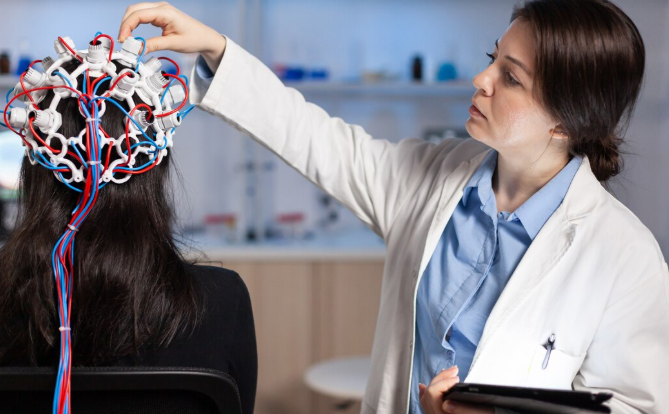
Scientists monitor activity in areas like the amygdala, which processes fear responses, inside research labs, which are frequently windowless and packed with screens and imaging equipment. There are patterns. Recalling trauma activates specific circuits. Others try to control that reaction. It’s a continuous, intricate dialogue that takes place inside the brain.
Eliminating memory completely is not the aim. That is still unattainable and possibly undesirable. Rather, the emphasis is on breaking the connection between distress and memory. altering the brain’s response to recollections of the past.
It’s difficult to ignore how delicate this method feels. Data is only one aspect of memory. It is connected to meaning, identity, and self-perception. Changing it, even a little, creates issues that science cannot fully resolve.
Additionally, timing is a problem. PTSD may be avoided by acting soon after trauma, but doing so necessitates quick action, frequently in a chaotic setting. It is more difficult to intervene years later. The memory is more robust and ingrained.
Different approaches are being tested by researchers. In order to lessen the emotional impact of recalled memories, some people combine therapy sessions with medication. Others investigate methods such as neurofeedback, which gently modifies the brain’s response. More sophisticated methods, such as optogenetics, are primarily used in research on animals, where light can either activate or silence particular neurons.
The extent to which this will result in widespread treatment is still unknown.
Therapists who work with PTSD patients frequently describe a particular moment. When describing a traumatic event, a patient’s voice is steady at first, but it becomes tighter as details become clear. Even though the threat has long since passed, the body responds—heart rate increases, breathing changes. These new strategies seek to alter that response.
Something fundamental would change if the memory could be retrieved without starting that chain reaction. Not forgetting, but remembering in a new way.
The emergence of this research coincides with increased awareness of mental health issues as well as increased demand for solutions. Millions of people, including veterans, accident survivors, and victims of violence, suffer from PTSD. Current therapies are helpful, but not always.
This new path seems to offer cautious hope. A slow opening of possibilities rather than a dramatic breakthrough.
Skepticism persists, though. Memory is even more complicated than the brain itself. Unintentional consequences may arise from interfering with one aspect of the system. One pathway is strengthened while another is weakened. The equilibrium is precarious.
Questions of ethics come next. What about other types of memories if traumatic ones can be changed? Where does improvement start and treatment finish? These are already being discussed in academic circles, so they are not abstract issues.
Treatment for PTSD may look very different in the future than it does now. Reshaping memory is more important than maintaining it. However, it’s also possible that progress will be more gradual and slower than what the headlines portray.
For the time being, the work is done in controlled settings, such as clinics, labs, and quiet rooms where patients sit and talk while remembering things they would prefer to forget.
Additionally, memory itself is being reexamined at some point during that process. not as something unchangeable and unalterable, but as something that is subject to change.
Take caution. Not sure. And without repercussions.