
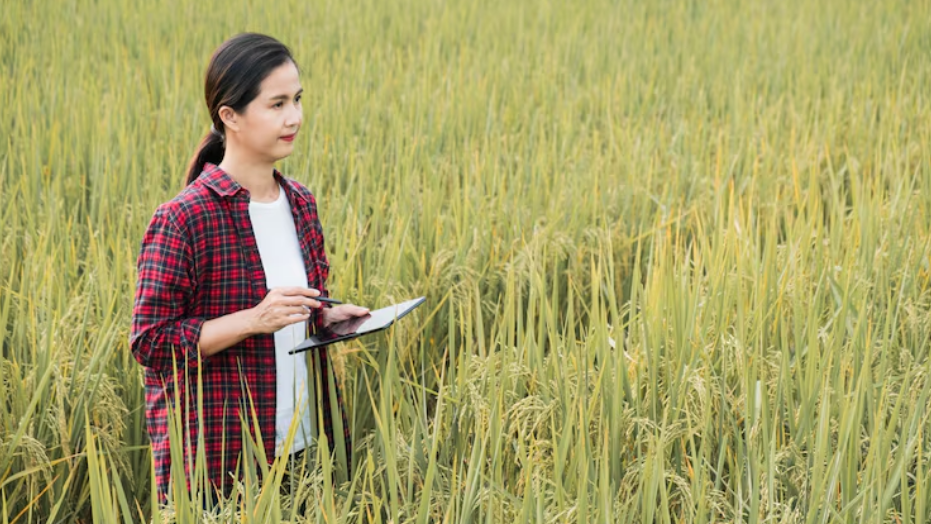
A flooded paddy field at dusk has a certain stillness. The flat surface of the water reflects what’s left of the sky, but beneath that serene surface, something unglamorous is taking place: microbes are breaking down organic matter and releasing methane, an invisible gas, into the warming air above.
Every year, about 51 million hectares of land in India do just this, and the world of climate finance has finally begun to take notice.
| Topic Snapshot | Details |
|---|---|
| Sector | Agricultural methane mitigation, India |
| Land under paddy cultivation | Over 51 million hectares |
| Methane emitted from paddy (2020) | Approx. 3.2 million tons |
| Share of agricultural methane | Around 23% |
| Key practice in focus | Alternate Wetting and Drying (AWD) |
| Average water saved (per acre, AWD vs CF) | 1.82 million litres |
| Methane reduction observed | ~42% (Mitti Labs, Warangal study, 2024) |
| Yield impact | Negligible — both methods around 2.5 tonnes/acre |
| Smallholder farmers in India | Over 86% own less than 2 hectares |
| Lead research engagement | CPI’s MASFMA program, supported by Global Methane Hub |
| Roundtable date | 7 April 2026 |
On paper, the figures are depressing. About 25% of the nation’s agricultural methane emissions in 2020 came from paddy cultivation, which released 3.2 million tons of methane. Methane has a comparatively short atmospheric life of about twelve years, so it doesn’t last as long as carbon dioxide, but while it does, it is incredibly effective at trapping heat. Strangely, the optimism stems from that short lifespan. Reduce methane now, and the climate reacts fast. This asymmetry appears to have caught the attention of investors, and money is starting to move.
However, transferring funds is one thing. Another is farmers who relocate. Smallholders dominate India’s agricultural landscape; more than 86% of them work two hectares or less. It is not easy to persuade someone with five acres to change their approach, purchase new equipment, or put their faith in a new subsidy schedule. There is behavioral inertia.
In a nation where margins are already narrow, the fear of yield loss can also wipe out a season’s earnings. Speaking with people in this area gives me the impression that technology has surpassed trust.
Because of this, the topic of Alternate Wetting and Drying, or AWD, keeps coming up in almost every discussion. The method is almost insultingly straightforward: farmers flood the field for the first twenty days, then drain it twice over the next forty-five days, with each dry-down lasting roughly six days, rather than keeping it flooded for sixty-five days in a row. That’s all. No brand-new tractor. No new fertilizer schedule. Simply flip the water on, off, and back on.
Last kharif season, Devdut Dalal, co-founder of the Bengaluru-based climate-tech company Mitti Labs, conducted a study in Telangana’s Warangal district using 30 farmer fields, three villages, half conventional flooding, and half AWD. The outcomes were remarkable. The flooded plots used 4.96 million liters of water per acre, whereas the AWD plots used 3.14 million. Methane emissions decreased to 3.5 tonnes of CO2-equivalent per hectare from about 6 tonnes. What about the yield? Almost the same. In any case, 2.5 tonnes per acre. Dalal’s statement, “AWD is like turning off the tap while brushing your teeth,” resonates because it is accurate. Similar promise is shown by other practices. Under the correct circumstances, direct-seeded rice can reduce emissions by up to 40%. In pilot settings, the rice intensification system has increased yields. There is a technical menu.
The financing structures, the monitoring systems that lenders can genuinely rely on, and the patience to allow smallholders to adopt at their own pace are what’s lacking. To close that gap, CPI’s MASFMA work, supported by the Global Methane Hub, is currently bringing together legislators, funders, and implementation partners in early April. It is still genuinely unclear whether the discussion will result in actual capital reaching actual fields. As this develops, it’s difficult to avoid the possibility that the next chapter of India’s climate narrative may be quietly written in mud.