
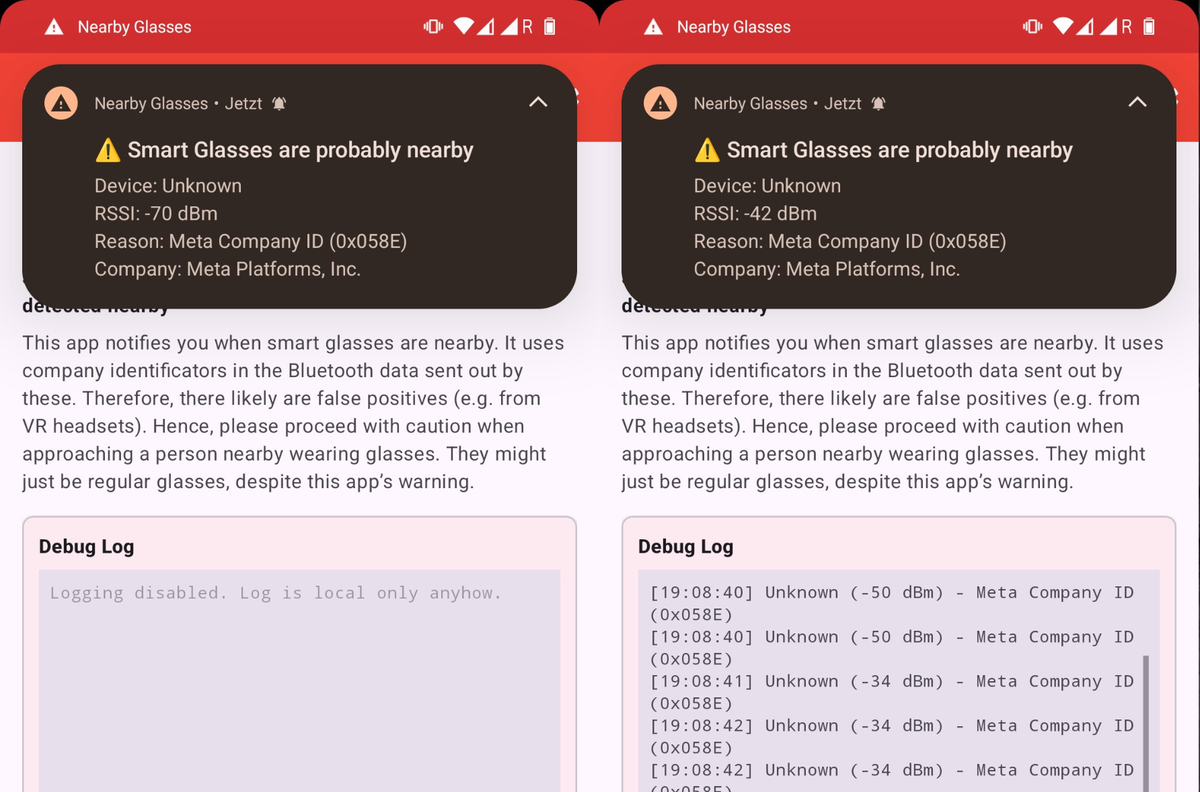
A new mobile application called Nearby Glasses has launched to help users identify when others nearby are wearing Meta’s Ray-Ban smart glasses, offering a privacy-focused response to growing concerns about covert recording in public spaces. The app was developed following reports that highlighted how individuals have been using the camera-equipped eyewear to film others without their knowledge. This privacy tool represents one of the first consumer-level attempts to address surveillance concerns surrounding smart glasses technology.
The application’s creator developed Nearby Glasses after encountering media coverage that detailed instances of people being recorded by Meta Ray-Ban wearers without consent. According to the developer, the application serves as what they describe as “a tiny part of resistance against surveillance tech.” The tool aims to alert users when these particular smart glasses are detected in their vicinity, providing a layer of awareness in environments where hidden recording may occur.
How Nearby Glasses Addresses Smart Glasses Privacy Concerns
The app functions by detecting the presence of Meta’s Ray-Ban smart glasses within a certain range of the user’s smartphone. When the camera-equipped eyewear is identified nearby, the application sends notifications to alert the user. This detection capability provides individuals with information about potential recording devices in their immediate environment, addressing a key privacy challenge posed by increasingly inconspicuous wearable technology.
Meta’s Ray-Ban smart glasses have generated privacy debates since their release due to their ability to capture photos and videos with minimal indication to bystanders. While the glasses feature a small LED indicator that illuminates during recording, critics argue this light is often too subtle to notice in many situations. Additionally, the glasses’ design closely resembles standard eyewear, making them difficult to distinguish from regular sunglasses or prescription frames.
Growing Concerns Over Wearable Surveillance Technology
The development of Nearby Glasses reflects broader societal concerns about privacy erosion in an era of ubiquitous recording technology. Smart glasses represent a new frontier in this debate, as they enable hands-free recording that is far less obvious than holding up a smartphone. Meanwhile, existing privacy laws in many jurisdictions have not kept pace with these technological advances, creating uncertainty about consent requirements and recording restrictions.
Privacy advocates have raised questions about the implications of normalized covert recording in public and semi-public spaces. The inconspicuous nature of smart glasses recording capabilities could fundamentally alter social interactions and expectations of privacy. However, technology companies maintain that their products include privacy safeguards and that users bear responsibility for adhering to local recording laws.
Technical Limitations and Privacy Protection Debates
Experts note that detection applications like Nearby Glasses may face technical challenges in accurately identifying specific smart glasses models among various Bluetooth and wireless devices. The effectiveness of such detection methods depends on the wireless signals emitted by the glasses and the proximity required for identification. In contrast to more obvious recording devices, smart glasses detection requires specialized approaches that continue to evolve alongside the technology itself.
The emergence of consumer tools designed to counter smart glasses surveillance illustrates the tension between technological innovation and privacy rights. Some observers argue that detection apps provide individuals with agency in protecting their privacy, while others question whether such tools can effectively address systemic surveillance concerns. Furthermore, the cat-and-mouse dynamic between surveillance technology and counter-surveillance tools seems likely to accelerate as wearable cameras become more prevalent.
The broader adoption and refinement of apps like Nearby Glasses will likely depend on public awareness of smart glasses privacy issues and the technical reliability of detection methods. Regulatory responses to wearable camera technology remain uncertain, with lawmakers in various jurisdictions still evaluating appropriate frameworks for balancing innovation with privacy protection in public spaces.