
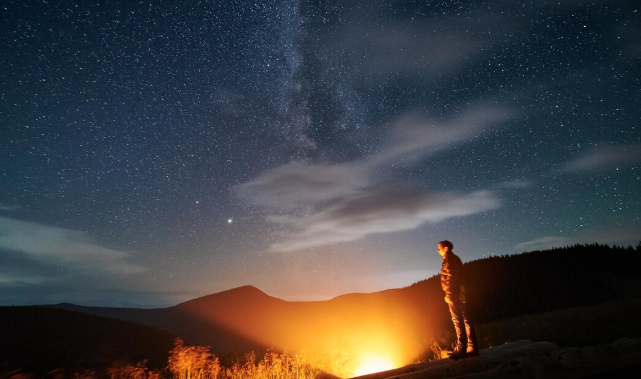
Lying on your back in a pitch-black field at three in the morning and watching a streak of light cross the sky and vanish in less than a second has a subtly humble quality. Not a replay. There isn’t a screenshot that accurately captures it. Just knowing that somewhere above you, a tiny fragment of rock that is older than anything on Earth has just burned up in the atmosphere. Every April, the dependable and steady Lyrids arrive, and this year they’re bringing company.
The Lyrid meteor shower peaks early on April 22 and lasts from April 15 to April 29. At its peak, the shower produces 15 to 20 meteors per hour, which is respectable and sometimes unexpected but not the most dramatic rate among yearly showers. In certain years, the Lyrids briefly produce nearly 100 meteors per hour during what astronomers refer to as an outburst. One of the things that makes watching worthwhile is that no one can accurately predict when that will occur. According to Popular Science, the Lyrids are known to produce “uncommon surges,” and this April might be one of those occasions.
| Event | Lyrid Meteor Shower 2026 |
|---|---|
| Active Period | April 15 – April 29, 2026 |
| Peak Night | April 21–22 (best viewing: pre-dawn April 22) |
| Origin Comet | C/1861 G1 Thatcher (orbits every 415.5 years) |
| Expected Rate | 15–20 meteors/hour (up to 100 in rare outbursts) |
| Radiant Location | Constellation Lyra, northeast of Vega |
| Also Visible | Comet C/2025 R2 (SWAN), Comet C/2025 A6 (Lemmon) |
| Equipment Needed | None (naked eye sufficient; binoculars helpful for comets) |
| Best Viewing Conditions | Dark skies, away from city lights, after midnight |
| Reference Website | NASA Skywatching |
Comet Thatcher, officially known as C/1861 G1, is the source of the shower. It is a long-period comet that only revolves around the sun once every 415.5 years. The last time it was near the sun was in 1861, when photography was still a novelty and Abraham Lincoln had just taken office. Every April, the debris trail it left behind travels across Earth’s orbit. What we see as meteors are actually tiny pieces, most no bigger than a grain of sand, that burn up as they strike the upper atmosphere at speeds of tens of thousands of miles per hour. Luminous dust trains, or spectral streaks that remain for a few seconds after the meteor has passed away, are another characteristic of the Lyrids. It’s worth waiting for those.
Look northeast toward the constellation Lyra, which is close to Vega, one of the brightest stars in the April sky, to locate them. The radiant, which lies between Lyra and Hercules, is where the meteors seem to fan outward. Although it’s not ideal, it’s a common instinct to look directly at the radiant. The meteors closest to that location will appear to have the shortest tails. You are more likely to notice the long, striking streaks if you look slightly away from it and let your peripheral vision do more of the work. The optimal window occurs between midnight and dawn, when the sky’s geometry is most advantageous and the radiant climbs to their highest point.
In addition to the meteor shower, there are two other noteworthy visitors to April’s sky this year. When amateur astronomer Vladimir Bezugly first noticed Comet C/2025 R2 (SWAN) in September 2025, it took professional astronomers by surprise because it was approaching from the sun’s direction and was obscured by glare until it was very close.
This is a truly once-in-many-lifetime opportunity because it is estimated to complete one orbit around the sun approximately every 22,000 years. On April 27, it will get as close to Earth as possible. After sunset, observers in dimly lit areas should be able to see it in the western sky through binoculars, though it’s still unclear if it gets bright enough to see with the unaided eye. Any astronomer will tell you that comets don’t follow rules.
The second comet, C/2025 A6 (Lemmon), was found in January 2025 by the University of Arizona’s Mt. Lemmon SkyCenter. The skywatching community has already given it positive reviews this season. Before dawn, look northeast toward the Big Dipper. Around the final week of April, both comets will be in the sky at the same time. On clear nights, the possibility of witnessing a meteor shower with two comets overhead with just your eyes is the kind of thing that makes you wish more people knew to look up.
It’s difficult to avoid the impression that the night sky is nearly invisible due to modern life. With the exception of the moon and the brightest planets, everything is washed out by the light that floods upward from cities. A generation has grown up in a neighborhood where they have never seen the Milky Way. Because of this, evenings like the one that is approaching on April 22 feel almost like a tiny act of rehabilitation—a reason to drive twenty minutes outside of town, away from the orange glow on the horizon, and just wait. You don’t need an app. Not a subscription. All you need is a clear sky and patience.
A few pragmatic considerations are crucial for those who intend to watch. Choose an area with little light pollution; a suburban park on the outskirts of town is preferable to a city rooftop. Before you expect to see anything worth writing home about, give your eyes at least 20 minutes to acclimate to the darkness. Wear more clothing than you think is necessary because, especially outside of urban areas, the chill of pre-dawn April air can arrive suddenly. Instead of standing and straining your neck, which quickly becomes uncomfortable, try to lie flat. Additionally, turn off or dim the phone’s screen because it destroys night vision more quickly than anything else.
This year, April 22 is a Wednesday. Since it’s a weeknight, the majority of people will set a reasonable bedtime and completely miss it. Really, that’s their loss. The comets will not return, but the Lyrids will in April of next year and the year after. It will be 22,000 years before C/2025 R2 (SWAN) returns. Certain opportunities are just as uncommon as they seem.