
There is a particular type of pressure that develops gradually and you are unaware of it until someone says it aloud. Many in the aerospace industry quietly sighed in December 2025 when Jared Isaacman, the recently appointed administrator of NASA, stood in front of reporters and cited the Manhattan Project as an example of how America should approach nuclear propulsion in space. At last, someone had said it. There is a race. And the United States is currently lagging by practically all honest measures.
It has taken years for the situation to develop. NASA’s Mars Sample Return mission was estimated to cost between $8 and $11 billion by an independent review board back in 2023. This amount had increased from the initial estimate of less than $3 billion. Samples are unlikely to arrive on Earth before the 2040s, according to the revised timeline.
| Field | Details |
|---|---|
| Organization | NASA (National Aeronautics and Space Administration) |
| Founded | 1958, Washington D.C., USA |
| Current Administrator | Jared Isaacman (appointed December 2025) |
| Nuclear Mission Name | Space Reactor-1 (SR1) Freedom |
| Planned Launch | End of 2028 |
| Propulsion Type | Nuclear Thermal & Nuclear Electric Propulsion |
| Mars Travel Time (Nuclear) | ~3–4 months (vs. ~7 months conventional) |
| Lunar Budget Plan | $20 billion lunar surface base |
| China’s Mars Mission | Tianwen-3, planned launch 2028, sample return ~2031 |
| Key NASA Program | MARVL – Modular Assembled Radiators for Nuclear Electric Propulsion |
| Reference Website | www.nasa.gov |
NASA leadership deemed those figures intolerable by April 2024, halted the program, and returned to industry to look for alternatives. Seven businesses, including Lockheed Martin and SpaceX, were awarded $1.5 million each to research ways to reduce expenses and speed up operations. Whether any of their suggestions will happen quickly enough to be significant is still up in the air.
In the meantime, China declared in September 2024 that it would use two Long March 5 rockets to launch its Tianwen-3 mission in 2028. The idea is to land on Mars, gather samples, and bring them back to Earth by 2031. No country has ever returned with materials from another planet. In terms of scientific and symbolic significance, whoever completes it first will have achieved something comparable to the Moon landings, and China has a history of fulfilling its publicly declared space deadlines. The most recent evidence of this comes from the Chang’e 6 mission, which returned samples from the Moon’s far side in 2024. Those who keep a close eye on this believe that the US is still underestimating the gravity of the situation.
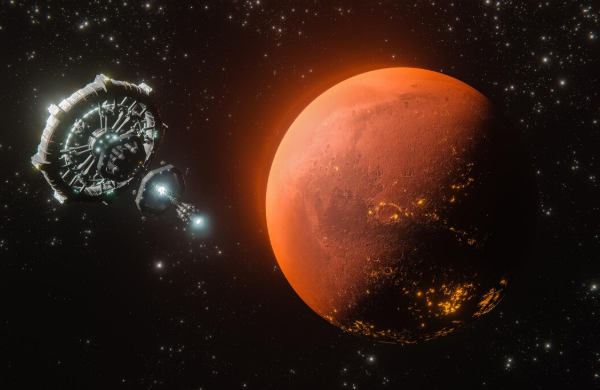
The spacecraft known as Space Reactor-1 Freedom is NASA’s response—at least the most spectacular. Launched by the end of 2028, SR1 Freedom is intended to be the first nuclear-powered spacecraft to reach Mars. It is more than just a scientific mission. According to Isaacman, it is intended to “bring nuclear power and electric propulsion from the laboratory to deep space”—a proof that this technology functions at scale, in the actual space between planets, rather than just on paper or in a testing facility. If the mission is successful, it will alter the nature of deep space exploration. If it doesn’t, it will be a costly and highly visible failure at the wrong time.
It’s important to comprehend the physics underlying the urgency. It takes about seven months for a traditional chemical rocket to travel to Mars. That trip could be completed in about three to four months by a spacecraft using nuclear thermal propulsion, which heats propellant and produces thrust using a nuclear reactor. It’s not a slight improvement. Reducing crew radiation exposure, lowering mission risk, and extending the windows in which missions can be launched feasibly are all made possible by cutting transit time almost in half. It’s the kind of breakthrough that completely reconstructs the strategic calculus of Mars exploration rather than merely modifying the current methodology.
For the past few years, engineers at NASA’s Langley Research Center in Hampton, Virginia, have been tackling one of the fundamental problems of nuclear electric propulsion. For something so important, the issue seems almost comically unremarkable: how do you control the heat? When fully deployed, the radiator array needed to dissipate the massive amounts of thermal energy produced by a nuclear reactor in space would be about the size of a football field. It appeared almost impossible to fit that into a rocket fairing, the nose cone that shields a payload during launch.
The suggested remedy is the MARVL project, which stands for Modular Assembled Radiators for Nuclear Electric Propulsion Vehicles. The plan is to launch the radiator in sections and robotically assemble it in space using liquid metal coolant flowing through connected panels, as opposed to packing the entire radiator into a single rocket. “One of our mentors remarked, ‘This is why I wanted to work at NASA, for projects like this,'” said Amanda Stark, principal investigator for MARVL and a heat transfer engineer at Langley.
Despite the fact that it’s an engineering challenge on top of another engineering challenge, the people working on it don’t seem to find that discouraging. That kind of enthusiasm is difficult to ignore. These individuals are not merely going through the motions. NASA’s Space Technology Mission Directorate funded the program for two years through the Early Career Initiative, indicating that the agency sees potential here rather than merely theoretical interest.
Beyond Mars, Isaacman has a more comprehensive strategic overhaul. He abandoned the planned Lunar Gateway space station in orbit and announced a $20 billion plan in March 2026 to construct a lunar base directly on the Moon’s surface. The Gateway was intended to serve as a platform for longer lunar missions and a waystation. International partners are genuinely uncertain if it is suspended; Canada, Japan, and the European Space Agency had all promised to contribute parts. Someone will have to bear the diplomatic expense. It remains to be seen if the surface base strategy produces faster results, but a clear philosophy is emerging: cut the middlemen, go straight, and move more quickly.
The scientific benefits of Mars exploration transcend national pride and geopolitical positioning. There is an atmosphere on Mars. There is proof of old water there. Above all, scientists genuinely think that life may have once existed there. When properly examined, a sample of Martian material may provide the first hard proof that life originated somewhere other than Earth. Without a doubt, that would rank among the most important scientific discoveries in history. If China were to be the first to return those samples, it would be more than just a symbolic victory; it would put China at the forefront of an international scientific dialogue that would fundamentally alter humanity’s understanding of its place in the cosmos.
Additionally, there are risks that are not sufficiently discussed. Until it is thoroughly examined, any material returned from a planet that may support life—even microbial or ancient—must be kept completely isolated from Earth’s surroundings. That process’s protocols are still being developed. China will be accountable for completing the first Mars sample return. That question might be answered flawlessly. It’s also possible that the United States shouldn’t want to be the second country to face that challenge instead of the first.
It is hard to avoid coming to the conclusion that NASA underestimated the scope of what it was trying to accomplish and the speed at which its competitors were advancing for the better part of ten years. The Gateway suspension, the Mars Sample Return cost overruns, and the lunar lander delays—SpaceX is reportedly two years behind schedule on its lunar lander, according to a recent NASA inspector general report—all indicate that the agency has been managing complexity rather than conquering it. The nuclear propulsion project seems like a real change in direction. Right now, the only thing that matters is whether it arrives in time.