
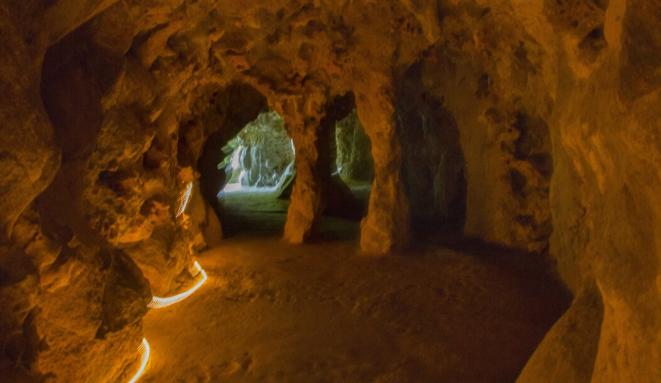
A diver descends below the surface and enters a world that has been forming for millions of years somewhere beneath the turquoise water and white limestone of Mexico’s Yucatán Peninsula, past the resort beaches of Tulum and through a network of sinkholes known locally as cenotes. The overhead light quickly dims. After narrowing, the tunnel opens into a large, flooded chamber before narrowing once more.
Except for the sound of breathing apparatus, there is complete silence. As of late 2025, scientists have confirmed that the Ox Bel Ha system, also known as the “Three Paths of Water” in the local Mayan language, is the longest known underwater cave system on Earth, spanning at least 326 miles of explored passage. Already astounding, that figure is most likely not the last.
| Yucatán Underwater Cave Systems — Key Facts & Discovery Profile | |
|---|---|
| World’s longest (current) | Sistema Ox Bel Ha — at least 326 miles (435.8 km) explored; Mayan for “Three Paths of Water” |
| World’s second longest | Sistema Sac Actun — 378.56 km underwater; 386.12 km total (incl. dry passages) |
| Location | Yucatán Peninsula, Quintana Roo, Mexico — near Tulum on Caribbean coast |
| Geology | Limestone karst; 228 cenote entrances (Sac Actun alone); max depth 119.2 m |
| Sac Actun discovery | November 26, 1987; connected to Dos Ojos in 2018 (Great Maya Aquifer Project) |
| Key explorer | Robert (Robbie) Schmittner — 14 years exploring Sac Actun; led Gran Maya Aquifer Project |
| Archaeological significance | 100+ archaeological contexts; oldest human skeleton in New World found here (Naia, teenage female) |
| Other remains found | Mastodon skeleton; extinct fauna; extensive Maya cultural artifacts |
| Maya significance | Caves considered sacred — entrances to the underworld; sites of ritual and sacrifice |
| Known fatalities | Dec 9, 2004 — Kent Hirsch & Michael Nast drowned after getting lost, exhausting oxygen supply |
| Latest update | Nov 2025 — Ox Bel Ha confirmed longer than previously believed; all systems may be connected |
| Reference | Live Science — Sistema Ox Bel Ha: World’s Longest Underwater Cave |
In November 2025, it was revealed that Ox Bel Ha extends farther than previously charted. This finding adds a new chapter to a decades-long narrative of exploration that has repeatedly compelled researchers to reevaluate their preconceived notions about the extent of what lies beneath the peninsula. For years, Ox Bel Ha and its nearby neighbor, Sistema Sac Actun, which is located along the Caribbean coast close to Tulum and currently has 378 kilometers of underwater passage with an additional stretch of dry cave bringing its total to over 386 kilometers, have been vying for the title of longest cave in the world.
Both systems are very large. The mapping of both is still ongoing. Additionally, scientists are coming to the conclusion that they are not distinct systems at all, but rather distinct branches of the Great Maya Aquifer, which may eventually be acknowledged as the largest known subterranean water network.
The more dramatic discovery story is found in the Sac Actun system. Robbie Schmittner, a cave diver and explorer, guided teams through Quintana Roo’s meandering tunnels for twenty years, charting passage after passage in the pitch-black freshwater beneath. The labor was tedious and often hazardous. The caves are a three-dimensional maze that Texas A&M marine cave researcher Thomas Iliffe has described as “really maze-like” in a way that almost comically understates the complexity.
They branch endlessly, dead-end without warning, loop back on themselves, and exist at multiple depths simultaneously. Two divers, Kent Hirsch and Michael Nast, were lost deep within Sac Actun in December 2004 and perished after running out of oxygen. Even though the cave appears calm in pictures, novice divers may not always understand how harsh it is.
After months of concentrated research, Schmittner’s team discovered what they had been searching for in January 2018: a subsurface link between Sac Actun and the neighboring Dos Ojos system close to Tulum. At 215 miles, the combined cave instantly surpassed Ox Bel Ha to become the longest known underwater cave in the world. Dos Ojos was merged into Sac Actun, and the entire complex adopted that name because cave exploration naming conventions required the larger system to absorb the smaller.
“This is an effort of more than 20 years,” Schmittner stated at the time. That statement contained both exhaustion and the quiet satisfaction of someone who had dedicated a large amount of his life to a single, massive problem and ultimately found a solution that altered the course of history.
What has been discovered within these caverns is what elevates them above mere geological curiosity. Over a hundred documented archaeological contexts, including pre-Hispanic Maya artifacts, ceremonial items, and proof of thousands of years of ritual use, can be found within the Sac Actun system. Some caves were more than just natural features to the ancient Maya. They served as entrances to the underworld, Xibalba, where priests could communicate with gods and the line separating the living from the dead became increasingly hazy.
These flooded passageways would have appeared to be just that—unreachable by regular people, existing in a different world due to their darkness and depth. The skeleton of a mastodon was discovered in March 2008 by divers investigating the Hoyo Negro pit, which is located 60 meters below the surface. The remains of a teenage girl named Naia, whose skull was found nearby at a height of 43 meters, may be the earliest proof of human habitation in the Americas. When the cave was still dry and sea levels were lower during the last Ice Age, she had fallen into the pit.
Considering what these systems contain—geology, archaeology, and ancient ritual piled on top of one another in the dark, beneath a section of coast that most tourists are only familiar with for its Instagram backdrops and cenote swimming—it’s difficult to avoid feeling the weight of that layering. Unaware that what lies beneath them connects, tunnel by tunnel, to chambers where a mastodon perished in the Pleistocene and a young woman’s bones waited 13,000 years to be discovered, tourists float in those same sinkholes and gaze up at the light filtering through the surface. The windows are the cenotes. The world is the cave.
How interconnected everything is is still a question that researchers are trying to answer. The geology contradicts the mapping of Ox Bel Ha, Sac Actun, Koal Baal, and Dos Ojos as distinct systems. This type of water-carved labyrinth is created by the gradual dissolution of limestone, a porous rock that covers the entire peninsula.
All of the major systems could be passages within a single massive aquifer, and many scientists now think this is likely. There is currently no reliable frame of reference for the total length, even if that connection is ever verified and fully mapped. One dive at a time, one tunnel at a time, 326 miles and counting, the exploration is still ongoing for the time being.