
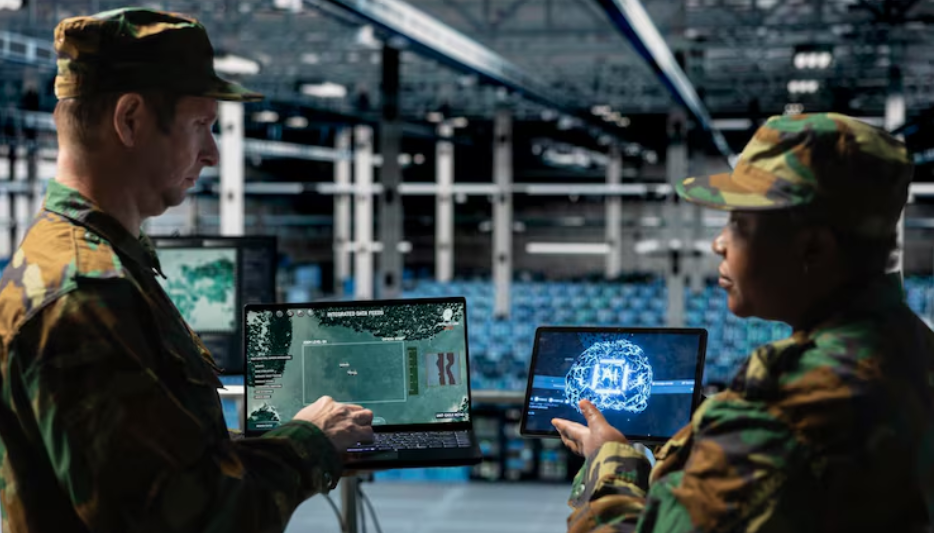
The sound is the first thing you notice when you’re close to Kharkiv at night. A thin mechanical buzz, halfway between an insect trapped in glass and a lawnmower, rather than explosions, which come later. In the middle of a conversation, soldiers pause, cocking their heads slightly to listen. They’re not merely following a drone. They are discreetly feeding a system that is learning back while they study it and gain knowledge from it.
It’s difficult to ignore how different this war feels. Not more accurate, not cleaner, just more… iterative. Data appears to be left behind by every encounter, not just damage.
| Category | Details |
|---|---|
| Country | Ukraine |
| Conflict | Russia–Ukraine War (since 2022 escalation) |
| Key Initiative | Brave1 Defense Innovation Platform (“Test in Ukraine”) |
| Notable Companies | Palantir Technologies, Quantum Systems |
| Military Alliances | NATO |
| Key Technologies | AI-enabled drones, autonomous systems, electronic warfare |
| Political Leader | Volodymyr Zelensky |
| Reference | https://www.nato.int |
By 2025, Western defense companies were being invited to test their newest systems in real combat as part of Ukraine’s “Test in Ukraine” program. The pitch was straightforward: send your software updates, drones, and AI models, and see what survives. No simulation, no matter how advanced, seems to be able to replicate what happens when GPS vanishes, signals are jammed, and decisions must be made in a matter of seconds. This may be the first conflict in which feedback loops are just as important as weaponry.
Businesses like Palantir Technologies and Quantum Systems provided code that is constantly evolving, sometimes on a weekly basis and other times more quickly, in addition to hardware. Engineers receive battlefield logs and transmit updates back to the field while seated far from the front. The idea of war as something that has been updated and patched, like software, is peculiar. As this develops, it seems as though the battlefield is becoming less static and more like a living system that is continuously changing.
However, the human factor continues to be obstinately important. The majority of AI systems still use a “human-in-the-loop,” which means that a decision is still made by someone, somewhere. However, it seems like there is less of a boundary now. Thousands of hours of drone footage are now processed monthly by Ukrainian systems, which identify patterns, flag movement, and suggest targets. It’s still unclear if commanders fully trust these recommendations or if they’re just learning to rely on them because there aren’t many options due to the pace.
It can all seem almost unreal in terms of economics. A 127th Brigade soldier once likened a small interceptor drone worth a few thousand dollars to a Patriot missile, which costs millions of dollars. He claimed that the drone could be landed, fixed, and then launched again. The suggestion persisted. Long dominated by costly systems, war is shifting toward something more affordable, flexible, and disposable. The future battlefield may be shaped by cost effectiveness rather than just lethality.
The change wasn’t made overnight. Early in the conflict, waves of Iranian-designed Shahed drones overwhelmed defenses, making it difficult for Ukrainian forces to repel them. Soldiers made do. They modified designs, examined failures, and repurposed damaged drones. One officer described how it felt more like a revelation than a victory when a Ukrainian drone shot down a Russian reconnaissance plane. He declared, “This is a drone war.” Once abstract, that realization evolved into doctrine.
The speed at which both sides adjusted is remarkable. To avoid electronic jamming, Russian forces deployed fiber-optic-guided drones, which Ukraine later adopted. The emergence of swarm tactics was followed by countermeasures and then counter-countermeasures. Timelines that used to span years are being compressed into months due to the speed of change, according to analysts like Samuel Bendett of CNA. Every innovation sets off a reaction, resulting in a cycle that seems almost biological—evolving, responding, surviving.
Western militaries are keeping a close eye on things. NATO planners are reconsidering doctrine regarding drone swarms, AI-assisted targeting, and electronic warfare after learning from Ukraine. It has a subtle sense of urgency. Companies that refuse to test systems in Ukraine run the risk of falling behind, according to officials. It’s a clear message: exposure to actual war is now necessary for relevance.
However, beneath the innovation is a sense of unease. AI-enabled “kamikaze” drones are no longer theoretical; they can lock onto targets and carry out strikes even in the event that communications are cut off. They do exist, but only in certain forms. When they are activated, they function somewhat independently, which makes people uncomfortable. What is the limit of human control? What occurs if a target is mistakenly identified by these systems?
It’s a moral dilemma that is developing in real time, not just a technical one. In Ukraine, civilian and military environments frequently overlap, making it difficult for algorithms to distinguish between them. In chaotic environments, even the most sophisticated systems—trained on enormous datasets—can falter. Technology seems to be developing more quickly than the frameworks intended to house it.
Nevertheless, the momentum persists. Ukraine, where autonomy, data, and human decision-making collide on a daily basis, has turned into something of a model for future conflicts. The nation did not intend to serve as this testing ground. Driven by necessity, it happened slowly and almost reluctantly. One pilot recalled the early days, saying, “We did it because we had nothing else.”
You remember that line. Because it implies that improvisational moments—soldiers modifying code in between missions, engineers rewriting algorithms after midnight, drones being fixed in low light before dawn—are shaping the future of warfare rather than laboratories or boardrooms.
Where this goes is still unknown. Maybe in the direction of more effective combat. Maybe in the direction of something more difficult to manage. However, it seems as though the shift has already occurred as you stand there and listen to that subtle mechanical buzz in the darkness. The machines are picking up new skills. And so we are in a different sense.