
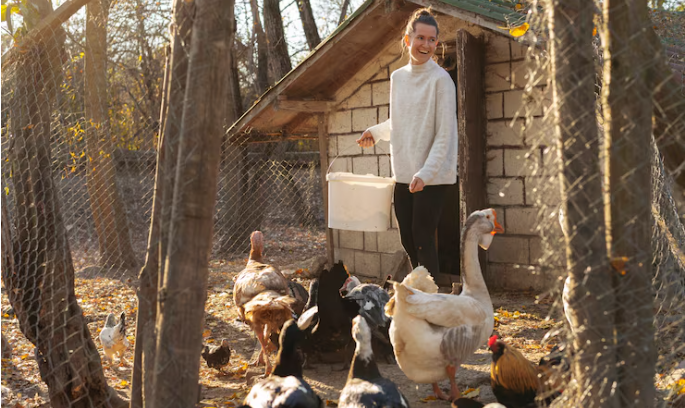
A subtle mixture of feed dust and disinfectant permeates the air at the edge of a chicken barn in southern Wisconsin. Employees take longer than usual to walk through footbaths, log entries, and double-check doors. It’s not a panic. Repetition is what it is. the kind that results from prior exposure to this.
The figures have begun to rise once more. As part of a larger surge that has been growing since early spring, more than 4.3 million birds in Wisconsin are currently impacted. On paper, it appears to be yet another migration-related seasonal increase. In actuality, it feels heavier this time, as though the virus has persisted and is now settling into something more enduring.
| Category | Details |
|---|---|
| Topic | Bird Flu (H5N1) Resurgence in Wisconsin |
| Affected Area | Wisconsin, United States |
| Key Industries | Dairy and Poultry Farming |
| Birds Affected (2026) | Over 4.3 million in Wisconsin |
| Nationwide Impact | Over 200 million birds affected since 2022 |
| Transmission Source | Primarily wild migratory birds |
| New Concern | Spillover into dairy cattle |
| Human Cases | 71 cases reported in the U.S. |
| Current Risk to Public | Considered low by health authorities |
| Reference | https://www.wpr.org/news/weve-seen-this-before-bird-flu-again-hits-wisconsin-poultry-farms |
Farmers are aware of a pattern. When wild birds arrive, they frequently pass overhead or settle close to bodies of water, going unnoticed at first. Then, a few days later, the barns undergo a change. Feed intake declines. The pace slows. Some birds pass away unexpectedly. Until it’s not, it’s subtle.
It’s possible that what’s happening right now is more of a continuation than an outbreak, a cycle that the industry hasn’t quite figured out how to break. Over 200 million birds have been impacted nationwide since 2022. This scale starts to change farmers’ perceptions of risk. Not as an infrequent occurrence, but as something that is constantly present.
But the increasing sense of spillover feels different. Many were taken aback when H5N1 was discovered in a Wisconsin dairy herd towards the end of last year. This story was not intended to include cattle, at least not in a significant way. And yet, there it was—a verified case connected to wildlife transmission, subtly compelling a reassessment of presumptions.
The rhythm is typically consistent inside dairy barns. Workers going through routine tasks, milking equipment humming, and cows lining up. Some people feel that a boundary is being crossed when they consider the possibility that a virus carried by migratory birds could enter that environment. The frequency of this type of transmission is still unknown, but even one instance has a tendency to linger in discussions.
Biosecurity is now practically a ritual. gates with only one entrance. devoted attire. Every day, equipment is cleaned. Visitors were restricted and logged in. Since previous outbreaks, the industry has adjusted by tightening regulations and decreasing farm-to-farm movement. However, infections still occur, indicating that control is limited when the source is seasonal and airborne.
When officials discuss it, there’s a subtle tension. The earlier terminology of containment is increasingly replaced by terms like “increased concern” and “heightened risk.” As this develops, it seems as though the virus has changed from something that can be eradicated to something that needs to be controlled continuously.
Farmers are making real-time adjustments. Some are delaying plans to expand by keeping birds indoors for longer periods of time and avoiding contact with open water. Others are just holding out hope that their businesses won’t be placed under quarantine next. Movement, sales, and culling can all be stopped by a single detection. The effects on the economy come swiftly, frequently before there is time to get ready.
It’s difficult to ignore how familiar this feels. In 2015, there was a significant bird flu outbreak in the United States that killed over 50 million birds. That was meant to be a pivotal moment. And in some respects, it was—monitoring increased, biosecurity improved. However, that scale has already been exceeded by the current outbreak, indicating that the underlying vulnerability is still present.
The human side is also there, albeit more subdued. In the United States, there have been 71 documented human cases, including one in Wisconsin. Although the public’s risk is still thought to be minimal, the numbers are there, just in the background. It’s not particularly concerning, but it’s also not unimportant.
Even in an indirect way, markets are keeping an eye on things. Prices for eggs have already demonstrated sensitivity to previous outbreaks, rapidly increasing when supply becomes constrained. With pasteurization lowering consumer risk, dairy appears to be more protected for the time being. However, confidence doesn’t always bounce back quickly after being shaken.
It’s hard to distinguish between what seems normal and what might be dangerous when you’re standing close to a fenced pasture and watching geese fly across a far-off field. The scenery appears unaltered, with open skies, peaceful farms, and ongoing routines. Beneath that exterior, however, plans are being postponed, decisions are being reevaluated, and safety measures are being strengthened.
There’s a feeling that Wisconsin is on the verge of an informal tightening, where options become limited and movement becomes cautious, rather than a formal lockdown just yet. Not declared, not announced. simply felt.
It raises an unanswered question: what does “normal” even mean for farms in the future if the virus has integrated itself into the environment rather than disrupting it?