
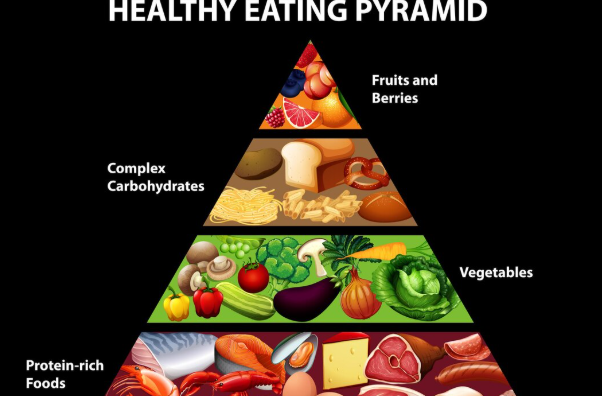
The chart is straightforward. Almost misleadingly so. An inverted triangle, bright and clean, placing meat, dairy, and fats at the top, while grains sit quietly at the bottom. It appears to be something that might be taped inside a nutritionist’s office or printed on a poster in a classroom. But standing in front of it—whether on a screen or a sheet of paper—there’s a sense that it’s not just a diagram. It’s difficult.
This new food pyramid, introduced under Robert F. Kennedy Jr., flips decades of dietary messaging on its head. For many years, Americans were instructed to base their meals on grains, such as bread, rice, and cereal, and to be cautious about fats and red meat. Now, protein and full-fat dairy are being pushed forward, reframed as central rather than supplemental. It’s a sharp shift, and not everyone seems comfortable with it.
| Category | Details |
|---|---|
| Policy Figure | Robert F. Kennedy Jr. |
| Policy | 2025–2030 U.S. Dietary Guidelines |
| Key Change | Inverted food pyramid |
| Focus Foods | Protein, full-fat dairy, healthy fats |
| Reduced Foods | Added sugars, ultra-processed foods |
| Controversy | Emphasis on meat vs plant-based diets |
| Impact Area | School lunches, SNAP programs |
| Expert Reaction | Mixed—support and concern |
| Environmental Concern | Increased meat consumption impact |
| Reference | https://www.npr.org |
Somewhere in the Midwest, children are picking up milk cartons, pizza slices, and fruit cups from trays that travel along a metal rail in a school cafeteria. What ends up on those trays will ultimately be shaped by these rules. That’s where the debate starts to feel less theoretical. It’s about what millions of people will eat without giving it much thought, not just charts.
Supporters of the new pyramid argue that it brings nutrition back to basics. whole foods. Fewer processed snacks. Less added sugar. That part feels hard to argue against. Walking through any grocery store, past aisles filled with brightly packaged snacks, it’s easy to see why there’s a push to simplify things. There’s a sense that something needed to change.
But the emphasis on protein—especially animal-based protein—has drawn attention. The guidelines suggest increasing intake, even though many experts say Americans already consume more than enough. It’s possible that this recommendation reflects a broader cultural shift, one that’s been building for years as high-protein diets gained popularity. Still, the question lingers: is more always better?
Some dietitians seem cautious, not dismissive but uneasy. They point out that focusing too heavily on protein could crowd out other important nutrients, particularly fiber, which many people already lack. There is a subtle conflict between simplicity and balance as this debate develops. A clearer message doesn’t always mean a more complete one.
Then there’s the visual itself, which might matter more than the text. The pyramid places foods like steak and cheese in prominent positions, larger and more visible than plant-based options. That choice feels intentional, but also slightly confusing. The written guidelines still advise moderation when it comes to saturated fats. The image, however, tells a different story.
It’s still unclear whether people will follow the pyramid at all. Historically, dietary guidelines have had a mixed track record. Many Americans know they should eat more vegetables and fewer processed foods, yet habits don’t shift easily. But this version might land differently. There’s a sense that people are already inclined to embrace protein-heavy diets, making this guidance feel more like validation than instruction.
Environmental concerns add another layer. Increasing meat consumption, particularly beef, carries implications beyond personal health. Farming practices, land use, emissions—all of it becomes part of the conversation. Some experts worry that the pyramid doesn’t fully account for these factors, focusing narrowly on nutrition while leaving broader consequences in the background.
Additionally, there is a cultural event taking place here. Food has always been tied to identity, tradition, even politics. The idea of “resetting” national dietary advice feels ambitious, maybe even a little risky. It suggests that previous guidelines were not just incomplete, but fundamentally flawed. That is a compelling assertion that warrants investigation.
As this develops, it seems that the new food pyramid is more about raising questions than it is about offering solutions. What is the true definition of a healthy diet? How much should individual preference matter? And who makes the final decision?
Although the pyramid provides a distinct shape, the surrounding environment is still disorganized. People eat according to convenience, culture, habits, and financial constraints. No diagram, no matter how well-made, can adequately convey that. Still, it influences. Silently, gradually.
And that might be the most interesting part. Not whether the pyramid is right or wrong, but how it reshapes the conversation. Standing in front of that inverted triangle, there’s a sense that something familiar has been turned upside down—and no one is entirely sure yet what that means.