
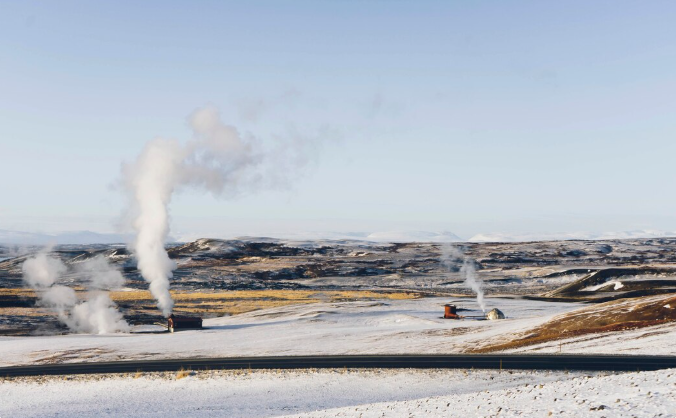
It doesn’t appear that an energy revolution will start in the Nevada desert. It feels permanently flat, dusty, and silent. Beneath that silence, however, engineers have been drilling sideways through hot rock to create an artificial reservoir that resembles a controlled geological experiment rather than a power plant. Even from a distance, it gives the impression that something ancient—something that has been hidden for billions of years—is at last being brought back to life.
The concept is not new in and of itself. For many years, geothermal energy has been used to power portions of the grid in volcanic areas and to quietly heat homes in Iceland. However, ambition has changed. Businesses such as Fervo Energy are no longer waiting for heat to naturally occur close to the surface. They’re pursuing it with deeper drilling, sideways pushing, rock cracking, and carefully regulated water circulation. It’s engineering that takes inspiration from the oil and gas industry while striving for a completely different result.
| Category | Details |
|---|---|
| Topic | Deep Geothermal Energy |
| Key Companies | Fervo Energy, Quaise Energy |
| Notable Location | Nevada Desert, USA |
| Technology | Horizontal drilling, millimeter-wave drilling |
| Potential Output | Up to 20% of global energy demand (estimates) |
| Current Share | ~0.34% of global energy |
| Key Advantage | 24/7 constant energy supply |
| Key Challenge | Deep drilling cost and technology limits |
| Reference | https://www.popularmechanics.com/science/energy |
It seems a little counterintuitive. The world has been chasing energy from the sky for years, with wind turbines rising over coastlines and solar panels stretched across deserts, but the most reliable source may have been beneath our feet the whole time. The molten core of the Earth continues to radiate heat. It will outlive all solar farms, batteries, and grid upgrades. That part seems almost too obvious, which may be why it was disregarded for so long.
Nevada has an almost elegant system. Water is forced into fractured rock, heated to extremely high temperatures, and then brought back up as a superheated liquid that transfers its energy through a secondary system rather than as steam. The loop never stops, silently. Don’t smoke. No deliveries of fuel. Just circles of heat. It’s difficult to ignore how straightforward it appears at first glance in contrast to the intricacy that lies beneath.
However, simplicity can be deceptive. The Earth becomes more resistant the deeper you drill. Rock shifts. The temperature rises. Equipment malfunctions in ways that seem almost inevitable. Conventional drill bits start to distort, even if they are composed of sophisticated alloys. This is where more recent methods, such as millimeter-wave drilling, begin to feel more like science fiction than engineering. These systems turn solid earth into gas and dust by vaporizing it rather than grinding through it.
One of the more closely watched players, Quaise Energy, is making an effort to do just that. The goal is to reach temperatures above 900 degrees Fahrenheit by drilling more than 12 miles below the surface. There is a subtle skepticism surrounding this bold goal. In theory, physics operates. The results of the lab tests are encouraging. However, putting that into practice on a daily, mile-by-mile basis feels like a completely different challenge.
Investors, however, appear to have faith. Money is flowing into geothermal energy in a way that wasn’t apparent five years ago. Some of it comes from well-known brands, such as tech firms seeking reliable, continuous power for data centers. Despite their growth, solar and wind power cannot ensure that. can be geothermal. That steady, unglamorous dependability is starting to gain value once more.
The statistics reveal an odd tale on a global scale. Today, less than 1% of energy is produced using geothermal energy. However, estimates indicate that if drilling technologies advance, it might be able to meet a significant portion of future demand. We might be witnessing one of those uncommon energy shifts that seems slow at first but isn’t. The kind that develops subtly before becoming apparent in retrospect.
One phrase that keeps coming up when talking about geothermal energy is “always on.” It’s important even though it’s not showy. Geothermal energy simply operates, in contrast to solar panels that sleep at night or wind turbines that wait for air that might not arrive. The design of grids is altered by this consistency. It lessens the requirement for large amounts of storage. Everything around it is stabilized by it.
However, it’s still unclear if the economics will live up to the promise. Deep drilling is costly. dangerous. unpredictable at times in ways that spreadsheets find difficult to account for. Months of progress can be undone by a single failed well. Even as technology advances, that uncertainty persists.
Additionally, there is cultural reluctance. Solar panels, wind farms, and electric vehicles are examples of energy revolutions that are often visible. Geothermal energy is concealed. It takes place underground, out of sight, and is nearly impossible to remember. It doesn’t make an announcement. If it functions at all, it hums softly.
As I watch this develop, I get the impression that geothermal energy is in a unique position. Not quite mainstream, not quite experimental. It takes patience from geology itself, optimism from clean energy, and credibility from oil drilling. It moves slowly. However, it has time.
due to the fact that the heat will not go away.