
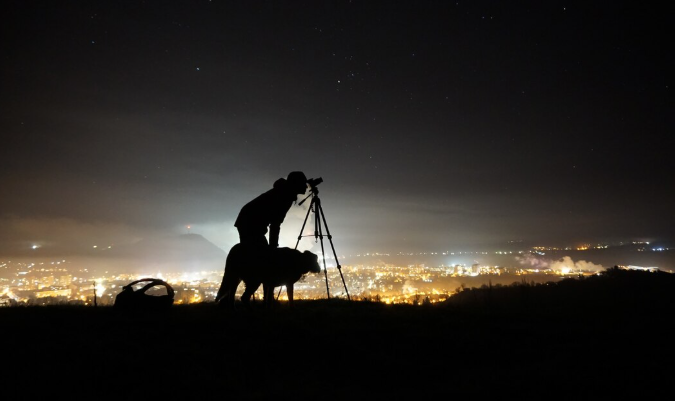
The sky may appear slightly different just after sunset tonight, but it takes a moment to understand why. Faint points of light will start to emerge above the western horizon, dispersed throughout the twilight in a soft arc. Some will be radiant. Others will seem hesitant, almost blending into the background stars. However, when combined, they create something unique: the Planetary alignment of February 2026, a six-world assembly of the Solar System.
It sounds more dramatic than it actually is when astronomers refer to it as a “planetary parade.” In reality, the planets are not positioned side by side in space. With their separate orbits around the Sun, they are still hundreds of millions of kilometers apart. However, from Earth, their trajectories coincide along the ecliptic, an imaginary line in the sky that gives the appearance of a celestial lineup.
| Category | Details |
|---|---|
| Astronomical Event | Planetary alignment February 2026 |
| Planets Visible | Mercury, Venus, Saturn, Jupiter, Uranus, Neptune |
| Best Viewing Time | 30–60 minutes after sunset |
| Where to Look | Western horizon |
| Naked-Eye Planets | Mercury, Venus, Saturn, Jupiter |
| Binocular/Telescope Needed | Uranus, Neptune |
| Astronomical Line | The ecliptic plane |
| Visibility Window | Late February – early March 2026 |
| Best Viewing Conditions | Dark sky, clear western horizon |
| Reference | https://science.nasa.gov |
It feels strangely personal to watch this play out. At once, six planets are visible. Stretching across the evening sky in a sweeping arc rather than a perfect straight line.
Jupiter will most likely be the most visible planet. It rises higher than the others, steadily illuminating the horizon with an unmistakable brightness. Hanging over the sky long after sunset fades, it appears less like a star on clear evenings and more like a silent beacon.
The scene gets more delicate lower in the west. Venus and Mercury appear momentarily before disappearing back into the twilight as they hover near the horizon. If trees or buildings obscure the skyline, they are simple to overlook. Surprisingly, a level, unhindered view—perhaps from a peaceful field or a hilltop—makes a difference.
Saturn is situated in between them. Compared to Venus or Jupiter, it doesn’t shine as brightly. Rather, it glows subtly, almost modestly, as though attempting to avoid drawing too much attention.
In an attempt to distinguish between a planet and a regular star, some observers may find themselves squinting at the sky. The experience includes that uncertainty. Seldom does the sky make a loud announcement about its secrets.
Neptune and Uranus are two more parade participants who need some assistance from technology. They appear as faint bluish points of light when viewed through binoculars or a small telescope. They easily blend into the background of far-off stars when not magnified.
How many casual stargazers will try to locate them is still unknown. Some people are content to identify the planets that are brighter, leaving the rest to experts in astronomy.
More than most people realize, timing is crucial. Thirty to sixty minutes after sunset is when the best window occurs. The sky is still too bright, and it’s too early. The lowest planets, particularly Mercury, sink below the horizon when it’s too late.
It can be oddly serene to stand outside during that brief window of twilight. The first stars appear overhead, birds settle into trees, and the air cools. One feels as though they are seeing something ancient rather than uncommon as they watch the planets appear one by one.
Contrary to popular belief, planetary alignments occur more frequently. In actuality, the sky is frequently shared by several planets. However, there is still a subtle thrill to seeing six at once.
The night sky feels different when you recognize those far-off worlds—tiny dots of light that represent entire planets. The stars no longer appear haphazard. Patterns start to show up.
It is occasionally noted by astronomers that alignments such as these influenced earlier periods of exploration. For instance, NASA was able to send the Voyager spacecraft on an amazing voyage through the Solar System in the late 1970s thanks to a unique arrangement of outer planets. Like stepping stones across space, the gravity of each planet propelled the spacecraft in the direction of the next.
There isn’t as much scientific significance to tonight’s alignment. Because of it, no spacecraft are launching. The Solar System is not being rearranged by cosmic forces. Nevertheless, there is a subtle significance to witnessing the six-planet parade.
It’s difficult to ignore how infrequently contemporary life inspires people to look up. Half the stars are obscured by city lights. Attention is drawn downward by phone screens. The sky, which was once the first map and calendar used by humans, is now largely disregarded above rooftops.
Such incidents gently break that habit.
Tonight, someone standing outside—perhaps on a balcony, a rooftop, or a quiet road—might abruptly recognize that Jupiter, not a star, is the bright point above the horizon. that Saturn might be the source of the faint glow in the area. That worlds with rings, storms, and frozen oceans exist somewhere beyond the shadows.
As I watch this develop, I get the impression that astronomy functions best when it feels more intimate than technical. The brightest planets don’t require a telescope. A clear western horizon and a few minutes of patience will suffice.
As the planets continue their sluggish orbits of the Sun, the parade will gradually disintegrate over the next few weeks. Almost silently, their tidy arrangement will disappear as if nothing noteworthy had occurred.
However, the Solar System is performing subtly for a brief period of evenings. Really, all anyone needs to do is go outside and face west.