
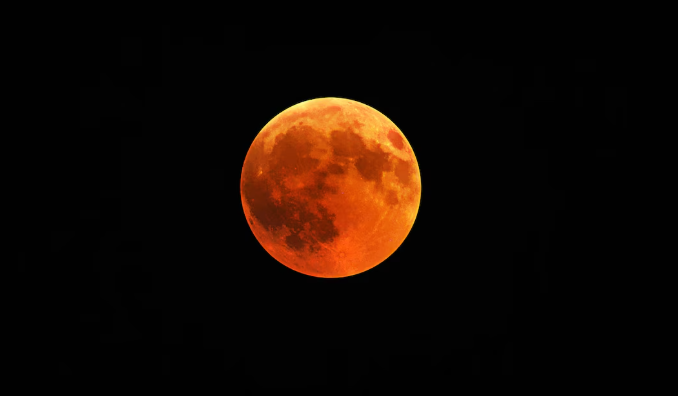
A lunar eclipse has a peculiarly alluring quality. The sky doesn’t yell about it. No flashing warnings, no thunder. Just a calm shift. Above city lights and rooftops, the Moon appears ordinary, pale, and familiar for a moment. Then the shadow of Earth starts to move slowly, almost courteously, across its surface.
Astronomers refer to this as a “blood moon” because on the night of March 3, that shadow will grow deeper until the Moon takes on a rusty red hue. The phrase sounds dramatic—maybe too dramatic—but watching it happen in real time makes the name feel oddly accurate.
| Category | Details |
|---|---|
| Event | Total Lunar Eclipse (“Blood Moon”) |
| Date | March 3, 2026 |
| Totality Duration | About 58 minutes |
| Entire Eclipse Duration | Approximately 5 hours and 39 minutes |
| Peak Time | Around 6:34 a.m. EST |
| Visibility | Asia, Australia, Pacific Islands, North & South America |
| Cause | Earth passes between the Sun and the Moon, casting its shadow |
| Why the Moon Turns Red | Rayleigh scattering filters sunlight through Earth’s atmosphere |
| Safety | Safe to view with the naked eye |
| Reference | https://science.nasa.gov |
At least on paper, the event’s mechanics are straightforward. By passing straight between the Sun and the Moon, Earth blocks sunlight and creates a shadow on the moon’s surface. However, sunlight does not entirely vanish. Rather, it bends through the Earth’s atmosphere, allowing the red wavelengths to reach the Moon while scattering the blue ones. The lunar surface is painted in copper and crimson hues by that filtered light.
Rayleigh scattering is the technical term for it. It appears unsettling to human eyes.
Over the course of about five hours, the eclipse will develop gradually, with the most dramatic part lasting just under an hour. The Moon will sit completely inside the umbra, Earth’s darkest shadow, during that time, which astronomers refer to as totality. The color frequently intensifies into something more akin to burnt orange or dark wine red during a peak eclipse.
In some areas, the show might be spoiled by clouds. With sky events, that’s always the risk. However, the timing is exceptionally favorable for millions of people in Asia, Australia, the Pacific, and the Americas. If the weather permits, over three billion people could witness at least some of the eclipse.
There is a subtly communal quality to that idea. People will go outside at various times of the night or early in the morning to gaze up at the same changing Moon in cities like Manila, Sydney, and Los Angeles.
Photographers captured the red Moon rising behind the Angel of Independence monument during a previous lunar eclipse in Mexico City. Ancient stone, contemporary traffic, and above it all, a copper moon floating in shadow, gave the scene a cinematic quality. Such moments serve as a reminder of how insignificant Earth’s everyday activities are in comparison to the solar system’s slow choreography.
The interesting thing is that a lunar eclipse feels much more serene than a solar one. Solar eclipses require careful timing and protective eyewear. Lunar eclipses don’t ask for much. No tools. No particular planning is required. Simply go outside and raise your gaze.
Lunar eclipses have always had cultural significance, which may be explained by their accessibility. Blood moons were occasionally interpreted by ancient societies as warnings or omens. Astronomers now use neat diagrams and orbital calculations to explain them. Nevertheless, it’s difficult to avoid feeling a slight reverberation of that previous uneasiness as you watch the Moon shift color above a peaceful residential street.
There is also a slight degree of rarity associated with the March eclipse. The next total lunar eclipse that will be visible from many parts of the world won’t occur until the end of 2028, according to NASA scientists. There is a subtle urgency added by that gap. The wait gets surprisingly long if you miss this one.
Naturally, not everyone will be observing from outside. The following morning, some people will browse through pictures on the internet, briefly noticing the red Moon before going on to something else. It appears to be the beat of contemporary life.
Nevertheless, there is a certain joy in seeing it for yourself.
The Moon gradually darkens as you stand in a quiet street before dawn, maybe with distant traffic humming in the background and chilly air settling over rooftops. The shadow grows darker. The color then emerges, faint at first, then distinct. It’s difficult to ignore the universe’s slow motion.
The Moon takes its time moving through the shadow of the Earth. It takes almost an hour for it to turn completely red as it drifts, patient and unconcerned. As you watch that process take place, you get the impression that the sky is carrying out a long-standing custom that people have been following for thousands of years.
At that point, it probably doesn’t really matter if it’s referred to as astronomy or just a stunning night sky.
Because it feels less like a scientific phenomenon and more like a reminder that the universe is still capable of surprising us when the Moon eventually turns red and hangs silently above the horizon.