
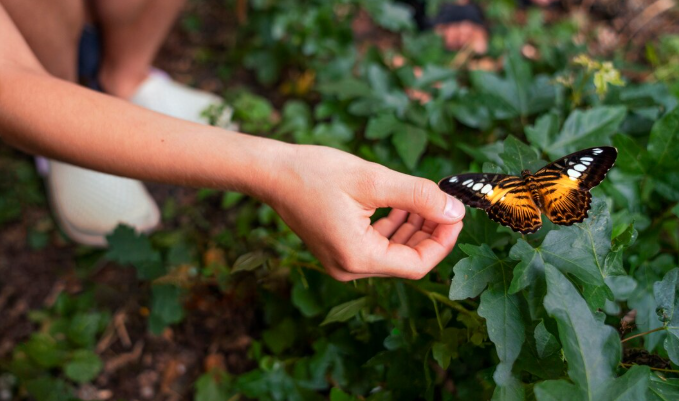
It feels oddly still in the late summer air in an Iowa field that was once covered with milkweed. Corn grows efficiently and consistently in tight green rows. The flicker of orange wings that once floated above the ditches along the roads is gone. In recent decades, the Monarch butterfly, which was once so common that kids could catch them in jars, has decreased by over 80% in some parts of North America. It sounds dramatic, that number. It’s quiet in the field.
It is true that the decline of the monarch is frequently presented as an environmental tragedy. The migratory population was listed as endangered by the International Union for Conservation of Nature in 2022. However, agriculture is another aspect that is given less consideration. Approximately 60% of crop plant species depend on animal pollinators, at least partially. For staple grains like corn and wheat, which rely on wind for pollination, monarchs are not the main pollinators. However, their disappearance is a sign of something more significant.
| Category | Information |
|---|---|
| Species | Monarch butterfly |
| Conservation Status | Classified as Endangered by International Union for Conservation of Nature (2022) |
| Pollinator Dependence | ~60% of crop plant species benefit from animal pollination |
| Economic Value | Pollinators contribute billions annually to agriculture |
| Major Threats | Habitat loss, pesticides, climate change |
| Key Resource | United Nations Environment Programme |
| Authentic Reference | National GeoGraphic |
In North America and Europe, pollinator decline has been documented; studies indicate that over the past few decades, insect biomass in some protected areas has decreased by more than 70%. Moths, bees, and butterflies are all slipping at the same time. The monarch is perceived as the most obvious victim, serving as a sort of spokesperson for a wider breakdown.
In California, the air usually hums when you walk through an almond orchard during bloom season. Farmers rely on pollination to establish their crop, and trucks unload rented beehives. Various estimates place the annual contribution of pollinators to agricultural economies in the billions. It appears that investors think managed honeybees can handle the load. However, it seems risky to rely solely on one domesticated species.
Milkweed, a plant that herbicides have wiped out from large tracts of farmland, is essential to the monarch’s life cycle. Fields are now cleaner—and empty—thanks to genetically modified crops that are resistant to weed killers. There might be an unstated ecological cost associated with this efficiency. Monarch larvae will have nowhere to grow if the milkweed is removed. If enough habitat is lost, migration will fail.
Another layer is added by climate change. Overwintering cycles are disrupted by warmer winters in Mexico, where monarchs congregate in mountain forests. Nectar sources along migration routes are diminished by droughts. It’s difficult to ignore a subtle alarm when watching footage of dwindling butterfly colonies clinging to trees. What does it mean for less mobile insects if a species that can travel thousands of miles is unable to adapt fast enough?
The effects on agriculture are not as immediate as those of a drought. Despite declines in pollinators, crop yields have continued to rise globally. Complacency is fostered by that fact. The existence of tipping points—the points at which a slow loss turns into an abrupt failure—is still unknown. Until they aren’t, ecological networks frequently seem stable.
Additionally, there is a nutritional component. Large amounts of the world’s vitamin A, folate, and vitamin C intake come from crops pollinated by animals. According to a modeling study, widespread pollinator loss may result in a nearly 25% reduction in fruit supplies and a 15% reduction in vegetable supplies, which could worsen malnutrition in areas that are already at risk. These forecasts are hypothetical. They are not unrealistic, though.
The tone is practical when speaking with farmers. Conservation programs are encouraging many to plant wildflower strips and hedgerows. Some are experimenting with integrated pest management or cutting back on the use of pesticides. Restoring habitat and lowering chemical pressure have been recommended by the UN Environment Programme and other organizations. Scale is the problem. Agriculture has narrow margins. It takes patience and incentives to change practices.
The monarch migration, which connects continents and stretches from Canada to Mexico, has cultural significance that is difficult to ignore. Students keep tabs on it. Its arrival is celebrated by communities. It feels like more than a biological statistic that that spectacle is gone. It seems like one’s experience is becoming more limited.
Global agriculture is not entirely pollinated by the monarch. However, its deterioration serves as a warning sign. Insects are the foundation of innumerable food webs that sustain soil health, birds, and small mammals. The structure above deteriorates if they are removed gradually.
Pollinator collapse is often viewed as an environmental problem distinct from economic expansion. It could be a fabricated separation. Because industrial agriculture is yield-oriented, it has also simplified landscapes, eliminating the diversity that insects rely on. Reintroducing complexity may be necessary for long-term productivity.
At the edge of a farm in the Midwest, next to a patch of restored milkweed, a lone monarch floats by, its wings beating steadily. After a brief landing, it lifts once more. As you watch it, you get the impression that there are many species at risk. Similar to migration, agriculture depends on continuity. Additionally, continuity appears increasingly precarious.