
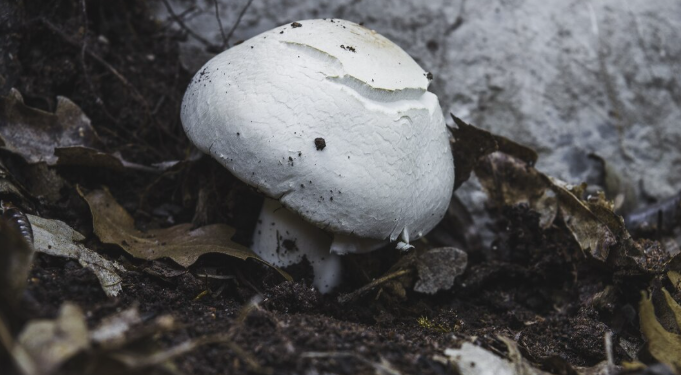
The future of Mars doesn’t appear metallic inside a lab at NASA Ames Research Center. It appears fibrous and pale, resembling a forgotten loaf of bread that is silently rising in the corner. Trays of mycelium spread outward on a stainless steel table, weaving through simulated Martian soil to create a substance that resembles foam insulation but functions more like living tissue.
The NASA Innovative Advanced Concepts-funded project, which involves growing habitats from fungus, initially sounds like science fiction. However, the scientists behind it describe structures that begin dormant and awaken with water, domes that expand after arrival, and bricks that can be grown rather than manufactured in calm, methodical tones. Perhaps the only reason the idea seems radical is because construction has always involved cargo ships, cranes, and concrete, not spores.
| Category | Information |
|---|---|
| Project Name | Myco-architecture / Mycotecture Off Planet |
| Lead Scientist | Lynn Rothschild |
| Agency | NASA |
| Research Center | NASA Ames Research Center |
| Funding Program | NASA Innovative Advanced Concepts (NIAC) |
| Core Material | Mycelium (fungal root-like network) |
| Habitat Concept | Three-layer dome (ice shield, cyanobacteria layer, mycelium shell) |
| Application | Moon and Mars habitats |
| First NIAC Phase | 2018 |
| Authentic Reference | https://www.nasa.gov/news-release/nasa-advances-research-to-grow-habitats-in-space-from-fungi/ |
Astrobiolog Lynn Rothschild, who once jokingly remarked that she never expected to pitch mushrooms to NASA, is spearheading the effort. Nevertheless, she is experimenting with mycelium, the subterranean network that makes up fungi’s bodies, because it grows remarkably effectively. Mycelium forms structures that can compete with some lightweight composites by weaving microscopic fibers into dense mats and fortifying itself as it grows. It can be formed inside molds under carefully monitored conditions, fed wood chips or yard waste, and then baked to stop its growth and produce stiff forms.
When we think about Mars, the appeal becomes more obvious. The cost of each kilogram launched from Earth is enormous. Conventional habitat designs carry shells across space like turtles. Even the most optimistic projections acknowledge that payload weight is still a constraint, despite investors’ apparent belief that scale and reuse will solve all problems. The equation changes when a portion of the habitat is grown on-site using biology rather than bulk cargo.
The current idea looks like a dome with layers. Locally harvested water ice could be used to create the outer shell, which would shield against radiation. Below that, cyanobacteria would produce nutrients and oxygen through photosynthetic activity. The structural core would be formed by the mycelium, the innermost layer, expanding around a lightweight framework. There is a feeling that architecture and ecology are subtly blending when viewing depictions of these domes glowing under a Martian sky.
Skepticism persists, though. Mars is hostile, cold, and irradiated. The ability of fungal composites to withstand severe temperature changes or prolonged radiation exposure without deteriorating is still unknown. In order to measure how fibers react to freezing nights and scorching days, engineers are currently stress-testing samples by subjecting them to simulated lunar and Martian conditions. Some preliminary findings are encouraging. Some people ask questions.
In one early experiment, students used mycelium to grow a stool in roughly two weeks. To be honest, it appeared to have been salvaged from a wet basement. After that, it was baked. It was occupied by people. It held. There was a “there” there, as indicated by that small piece of furniture that was grown rather than put together. As we watch that develop, we get the impression that we’re seeing a different industrial logic, one that is based on cultivation rather than extraction.
An additional layer of tension is added by planetary protection. Strict contamination regulations prohibit the introduction of Earthly organisms to Mars. The proposed remedy entails genetically altering strains of the fungi to prevent their survival outside of their habitat and enclosing them in sealed systems. Even so, discussions in policy circles go on in silence. If the romance of mushroom houses jeopardizes Martian science, it quickly fades.
The ramifications extend beyond Mars to Earth. A large amount of carbon emissions worldwide are caused by the construction industry. Grown from agricultural waste, mycelium-based materials provide less energy-intensive substitutes for steel and cement. It’s possible that Earth-bound structures grown in warehouses, which lower emissions while rethinking how cities rise, will be the most enduring legacy of off-planet research rather than Martian domes.
Though subtle, the broader cultural shift is apparent. Entrepreneurs from Silicon Valley discuss using robotics and rockets to colonize Mars. Something slower, almost agricultural, is suggested by this project. Astronauts may choose to hydrate dormant fungal mats and watch as walls enclose them rather than exploding habitats into existence. Assembly is being replaced by growth. Using patience instead of force.
Every timeline projection has some degree of uncertainty. By design, NIAC projects are in their early stages, and many never make it to operational status. However, NASA’s continued support of fungal architecture suggests institutional interest. not naive optimism. curiosity.
It’s difficult to ignore the irony. Space exploration has been associated with sterility for many years—clean rooms, polished alloys, and humming vacuum chambers. In an effort to create structural engineers, scientists are now growing organisms that flourish in decay—organisms that were once scraped off bread or tree bark. It’s an odd image. Even those who think of Mars as a chrome-plated frontier might find it unsettling.
Even so, the idea seems less ridiculous than it does when you’re standing in a lab with white threads weaving through red dust simulant. For billions of years, nature has been optimizing materials to solve structural issues at scales that are nearly incomprehensible to humans. It’s possible that learning how to allow something to grow will be the true architectural breakthrough for Mars rather than using heavier metals or more intelligent robots.