
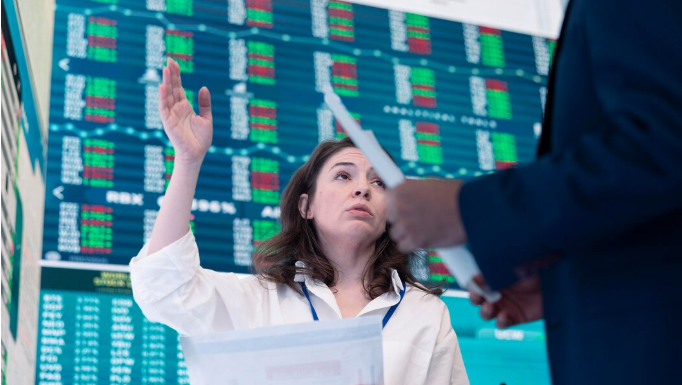
Early springtime brings a certain kind of anxiety to financial newsrooms. Earnings season is approaching, the light is better, and somewhere on a lower Manhattan trading floor, someone is staring at a screen that is refreshing more quickly than their coffee can cool. That was the case in March of 2026. Furthermore, it was the data that was subtly communicating beneath all of that noise, not just the nervous energy found inside glass towers.
The S&P 500 has not just declined. It has fluctuated, veering between optimism and retreat in a manner that is more akin to a market trying to decide than a correction. After riding a nearly unbeatable bull market for the past three years, investors are now wondering if a crash is imminent. This question usually seems absurd in prosperous times and excruciatingly urgent in difficult ones.
| Field | Details |
|---|---|
| Index name | S&P 500 (Standard & Poor’s 500) |
| Current level (Apr 3, 2026) | ~6,571 pts ▼ 0.18% session |
| 52-week range | 4,835 – 7,002 points |
| Year-to-date trend | Volatile; swung from gains to losses repeatedly |
| Shiller CAPE ratio | At a level seen only once before in 100+ years of data |
| Key market concerns | Iran conflict, pace of AI spending, elevated oil prices, recession fears |
| Top sector performers (YTD) | SCHD (dividends/value) up ~12%; outperforming QQQ, VGT, VOO |
| Analyst sentiment | Morgan Stanley’s Mike Wilson: 50% of Russell 3000 stocks already down 20%+ |
| Historical valuation tool | Shiller CAPE Index — inflation-adjusted price-to-earnings measure since 1881 |
| Reference / official data | Shiller PE Ratio — multpl.com |
It helps to look at something much older instead of this week’s headlines in order to achieve that. In more than a century of market history, the Shiller CAPE ratio, which measures stock valuations adjusted for inflation over a rolling decade of earnings, has only once reached this level. The dot-com bubble peaked at that one point in time. Almost everyone knows what happened next.
Maybe this time is really different. Naturally, that expression has a lengthy and embarrassing history. However, the argument is not frivolous: AI-driven productivity gains, structurally higher corporate margins, and a fundamentally altered interest rate environment could all theoretically support higher valuations in ways that the late 1990s did not. It is more difficult to determine whether investors have been telling themselves a convenient story or if they genuinely think that.
The fact that multiple indicators are flashing red at about the same time, rather than just one, is what makes the current image more unsettling. Oil prices have historically preceded equity market declines with unsettling regularity, and they have recently spiked significantly due in part to the ongoing conflict in Iran. A chart that shows that relationship over several decades is uncomfortable to look at. The economy can be affected by energy shocks gradually at first, then all at once.
This situation has a real and unaccounted-for geopolitical component. The S&P plummeted in a matter of hours after reports of increased military activity close to the Strait of Hormuz surfaced in late February. A week later, the index partially recovered and diplomatic signals softened. A warning sign in and of itself is this kind of daily whiplash, where the direction of the market is determined more by a single statement from a ministry of foreign affairs than by earnings or GDP data. Markets that react so strongly to headlines are those that have priced in a great deal of optimism and left themselves with very little margin for error.
The rotation that is subtly taking place beneath all of this volatility is difficult to ignore. Growth stocks, the high-multiple technology names and AI darlings that drove the bull run, have become less dominant. Interestingly, value stocks that pay dividends are doing well. SCHD, a fund that tracks dividend growers, has outperformed both VGT and QQQ by a significant margin, up about 12% so far this year. Money typically indicates something when it shifts from businesses that may eventually turn a profit to those that pay consistent dividends. Investors are hedging, even if they won’t admit it.
Half of all Russell 3000 stocks are down 20% or more, according to Morgan Stanley’s Mike Wilson, whose predictions have garnered attention for their accuracy. The extent of the damage occurring below the surface may be hidden by the index-level numbers, which are heavily skewed toward a few large-cap names. In other words, it’s possible that the market as a whole is already in correction territory; the headlines haven’t caught up yet.
None of this indicates that a crash is about to happen. The S&P 500 has a remarkable tendency to defy exactly what its own historical patterns seem to demand, and history provides probabilities rather than predictions. After the CAPE ratio reached high levels, stocks continued to rise for years longer than anyone could have predicted. By itself, valuation is a poor tool for short-term timing. It excels at setting context, and at the moment, the situation is that stocks are pricey, sentiment is brittle, geopolitical risk is high, and the type of investors who usually know things first have been stealthily shifting toward safer ground.
It’s not really a question of whether the market will crash. The question is whether the current evidence—the oil spike, the flight to dividends, the Iran overhang, the CAPE at historic extremes—adds up to something that should alter the actions of a prudent investor. The answer is most likely yes, based on what a century’s worth of data tends to indicate. Not because a crash is inevitable, but rather because there is much less room for error. Additionally, surprises often come at the worst time on Wall Street when margins are narrow.