
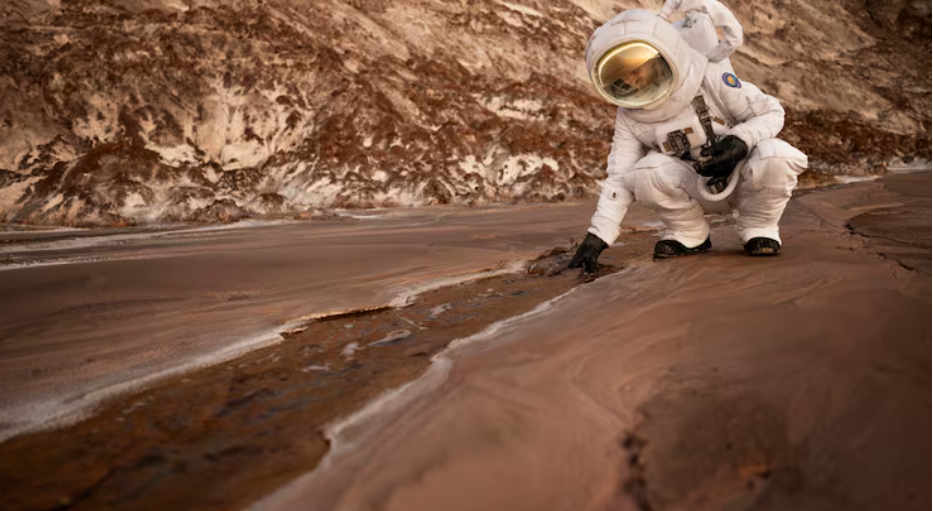
At first glance, the notion that a microbial colony could one day aid human survival on Mars seems almost fanciful. However, scientists are starting to approach the idea with unexpected seriousness in quiet labs, some of which are filled with artificial Martian soil. Could microscopic life aid humans in building homes on another planet? This question, which began as a curiosity about microbial chemistry, is gradually evolving into a useful engineering question.
There has always been a certain romance associated with Mars. Despite the harsh conditions, it feels oddly familiar with its red deserts, tall volcanoes, and old riverbeds. Less than 1% of Earth’s air pressure is present. The temperature drops to almost –90°C. Radiation sweeps across the surface with little resistance. Without protection, standing there would be fatal in a matter of minutes. On Mars, a shelter cannot just be a structure. It must act more like a wall-wrapped life support system.
| Category | Details |
|---|---|
| Research Focus | Microbial biomineralization for Martian construction |
| Key Microorganisms | Sporosarcina pasteurii, Chroococcidiopsis |
| Related Mission | Mars Sample Return (MSR) |
| Key Location | Jezero Crater, Mars |
| Supporting Research Fields | Astrobiology, microbiology, materials science |
| Space Agencies Involved | NASA, European Space Agency (ESA) |
| Key Concept | In-situ resource utilization (ISRU) |
| Potential Applications | 3D-printed habitats, oxygen generation, biomining |
| Relevant Experiment | BioRock experiment aboard the International Space Station |
| Reference Source | https://www.nasa.gov |
It is not feasible to ship building supplies from Earth. A tiny fortune is spent on each kilogram launched from our planet. For years, engineers have understood that using Martian soil itself is the only practical solution. In technical terms, the idea is known as “in-situ resource utilization,” but in layman’s terms, it simply means using what already exists. Microbes enter the picture at this point.
When examining rover data from Jezero Crater, researchers studying Martian regolith—the dusty mixture of crushed rock covering the planet—noticed something interesting. Minerals found in soil have the potential to form solid material if certain conditions are met. How to initiate that change without transporting massive industrial machinery across millions of kilometers of space was the question. It turns out that nature has been resolving comparable issues for billions of years.
On Earth, microorganisms routinely reshape geology. Long before complex life emerged, microbial processes in shallow waters gave rise to coral reefs, limestone formations, and even portions of the planet’s oxygen-rich atmosphere. Researchers looking into those prehistoric systems started to wonder if microbes could serve as space construction workers as well.
The unusual collaboration between two organisms—Sporosarcina pasteurii and Chroococcidiopsis—is the focus of the current experiment. One is a bacterium that uses a chemical process known as ureolysis to produce calcium carbonate. The other is a resilient cyanobacterium that is well-known among microbiologists for enduring conditions that would be fatal to most life, such as high radiation zones, dry deserts, and even conditions that are similar to those on Mars. When they work together, they act almost like a tiny construction crew.
Chroococcidiopsis secretes sticky protective compounds and produces oxygen inside lab reactors filled with Martian soil simulants. These compounds protect the bacterial partner from UV light. In exchange, Sporosarcina pasteurii starts creating mineral deposits that solidify loose soil particles into a mass that resembles cement.
It feels strangely dramatic to watch this process take place under a microscope. Solid structures are gradually formed from fine dust. The change is noticeable, slow, and almost silent. The idea that living things could one day build the walls of a Martian habitat is both fascinating and unsettling.
In the future, scientists envision robots combining microbial cultures with Martian regolith and feeding the mixture into 3D printers. With just soil, microbes, and sunlight, structures could emerge from the earth layer by layer. It sounds audacious. Maybe too daring.
How these organisms would react to actual Martian radiation and gravity remains a major mystery. Lab simulations help, but Mars remains stubbornly difficult to recreate on Earth. Fluid circulation around microbial colonies is altered by gravity alone, which has an impact on the movement of nutrients and the buildup of waste.
During the European Space Agency’s BioRock experiment on board the International Space Station, space scientists got a tiny hint. In that study, rare earth elements were successfully extracted from basalt rock by microbes operating in microgravity. Although it wasn’t precisely construction, it did show something crucial: microbial chemistry still works even when gravity acts differently.
Many researchers were quietly thrilled by that discovery. Microbes might be able to change the soil on Mars if they can mine rock in orbit.
The ramifications go beyond constructing shelters. As byproducts, some of these microbial systems also emit ammonia and oxygen. Small agricultural ecosystems within sealed habitats may eventually be supported by those outputs. In space engineering circles, the concept of a closed-loop living system—where microbes aid in resource recycling—is gaining traction.
The timeline is still unknown, though. In the 2030s, NASA and the European Space Agency intend to return samples from Mars that will include fragments of Jezero Crater to labs on Earth. Instruments far too big for spacecraft will be used to study those samples. Researchers want to know if there was ever microbial life on Mars.
It’s difficult to ignore this odd symmetry. While preparing to send new microbes to Mars, humanity is also looking for signs of ancient microbes there.
It’s still unclear if these experiments will eventually result in microbial construction crews on the Red Planet. However, it appears that space exploration is gradually moving away from rockets and metal and toward biology as the research advances.
And maybe that makes sense. After all, microbes shaped the planet around them at the beginning of life on Earth. If humanity‘s expansion into space started in the same manner—quietly, with organisms too small to see, gradually transforming alien dust into something like home—that would be oddly fitting.