
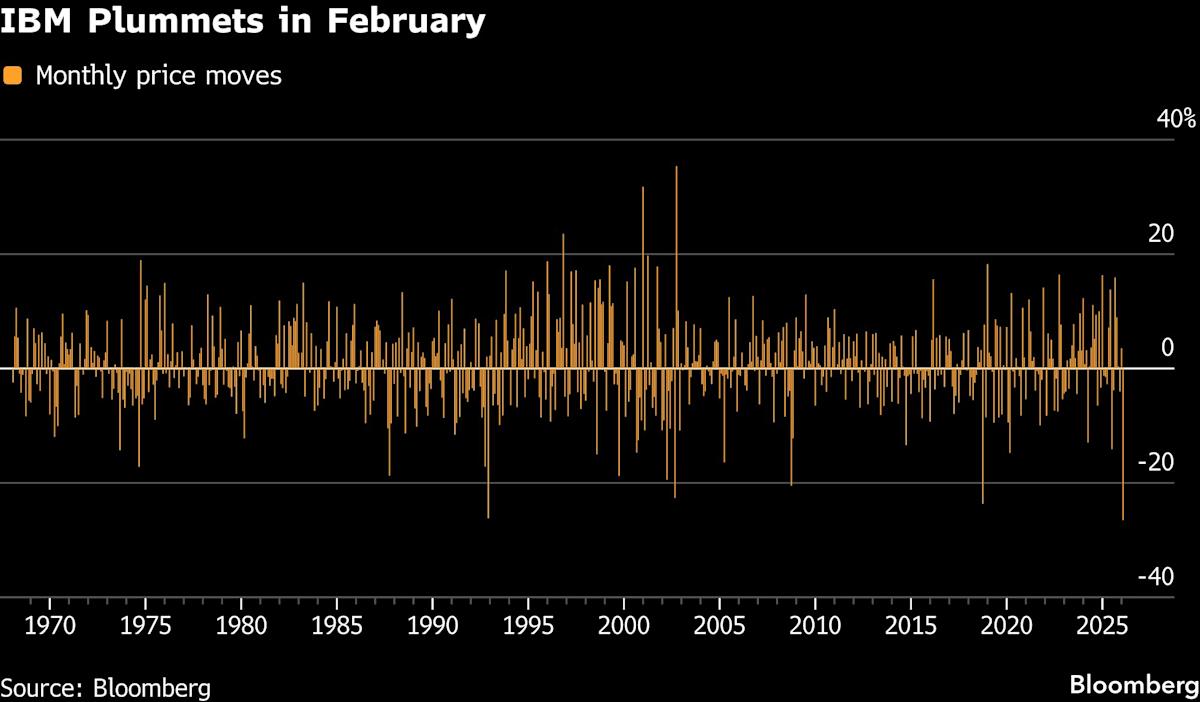
Investors continue to flee software stocks as several major companies prepare to report quarterly earnings this week, with fears mounting over artificial intelligence disruption. According to Bloomberg, companies including Workday Inc., Salesforce Inc., Intuit Inc., Autodesk Inc., and Snowflake Inc. are set to announce results, but market watchers say management teams face an uphill battle to restore investor confidence amid widespread concerns about AI’s impact on the sector.
The iShares Expanded Tech-Software Sector exchange-traded fund tumbled 4.8% on Monday following a Citrini Research report outlining potential AI risks to software companies. The fund, known by its ticker IGV, has plunged 27% since the start of 2026, putting it on track for its worst quarterly performance since 2008. Meanwhile, individual software stocks have suffered even steeper declines, with Intuit down 46% year-to-date, Workday falling 39%, and Salesforce dropping 30%.
AI Disruption Fears Drive Software Stock Selloff
The pessimism surrounding software companies centers on new AI tools from firms like Anthropic, OpenAI, and Alphabet Inc. that enable users to write software code through AI assistance, a capability known as “vibe coding.” If these tools allow anyone to create their own applications, it could significantly diminish demand for traditional software products. On Tuesday, Anthropic unveiled additional AI tools designed to automate work in fields including human resources, investment banking, and design.
“Everyone wants to just hit the sell button and get out,” said Jack Janasiewicz, lead portfolio strategist at Natixis Investment Managers Solutions, which manages $1.4 trillion in assets. He added that software companies are currently “guilty until proven innocent” in the eyes of investors.
Strong Fundamentals Clash with Market Sentiment
However, the actual financial results paint a different picture than the stock market performance suggests. According to data compiled by Bloomberg, 87% of the 15 software companies in the S&P 500 that have reported earnings this season have beaten profit expectations, while 67% have exceeded revenue forecasts. Additionally, roughly 75% of all S&P 500 companies have surpassed their earnings estimates.
This disconnect has led Bank of America strategists to declare software “the new value sector” in a February 20 note to clients. The S&P 500 software and services index now trades at less than 21 times forward earnings, marking its lowest valuation in more than three years and well below its five-year average of 29 times earnings.
Salesforce, which reports results on Wednesday, is expected to post revenue growth of approximately 12% and a 10% increase in adjusted earnings compared to a year ago. The stock now trades at about 13 times estimated earnings, the cheapest valuation in the company’s history. Similarly, Workday is trading at a record-low multiple despite expectations for double-digit revenue growth.
Uncertainty Clouds Long-Term Software Stock Outlook
Nevertheless, the uncertainty surrounding AI’s ultimate impact makes long-term forecasting challenging for the software sector. While expectations for 2026 software earnings have improved, 2027 estimates have declined since December, according to Bloomberg Intelligence data. This marks a significant shift for an industry that historically generated consistent and predictable growth.
“The level of uncertainty is so high that I’m not sure you can make peace with estimates past 2026, which means it’s hard to say that software as a whole is cheap, even if some names will ultimately be winners,” said Sameer Samana, head of global equities and real assets at Wells Fargo Investment Institute.
The skepticism extends beyond immediate earnings results. Samana noted that positive announcements would likely only postpone concerns rather than eliminate them. “If we see positive results, it will be a sigh of relief that AI is a 2030 story, not a 2027 story,” he said, adding that “ultimately the direction is in the path of huge disruption, and not everyone is going to make it.”
Wall Street analysts remain cautious about the sector’s ability to recover quickly, with many viewing this week’s earnings reports as unlikely to fundamentally shift sentiment. The coming days will reveal whether software companies can provide enough clarity about their AI strategies to stabilize investor confidence, though authorities have not indicated any regulatory interventions to address the market turmoil.